17, July 2021
Southern Cameroons Crisis: Yaoundé says Amba fighters disguised as military kill, loot 0
Cameroonian officials say anglophone rebels are taking a new tack in their fight to break away from the country’s French-speaking-majority. Officials say the separatists have started disguising themselves as military troops to infiltrate villages and launch attacks.
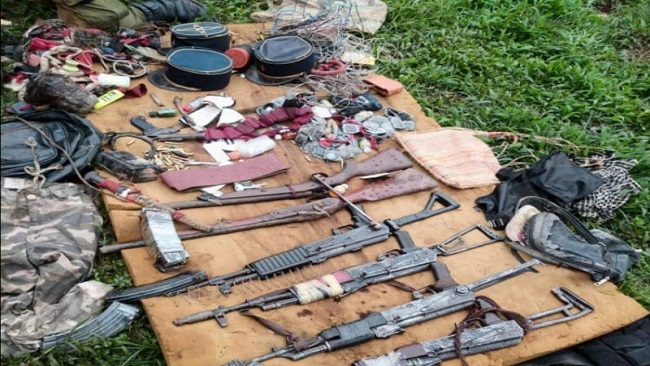
In a video widely circulated on social media platforms, including Facebook and WhatsApp, a group of 10 men armed with AK-94 assault rifles claim they are separatist fighters. The men, in civilian clothing, appear to brandish Cameroonian military uniforms, guns, ammunition and bulletproof vests they say they seized from Cameroon military. The men display a man’s head claiming it is that of a government soldier they killed and beheaded.
Cameroon’s military says the head displayed by the fighters as a trophy is that of one of its troops deployed to Babadjou, a French-speaking commercial town on the border with the English-speaking North-West region.
Awah Fonka, governor of Cameroon’s West region, where Babadjou is located, said more than 20 English-speaking separatists from Pinyin, a town in the North-West region, infiltrated the French-speaking West region Wednesday. He said the fighters attacked government troops and looted Babadjou shops.
Fonka said two government troops were killed by fighters disguised in Cameroonian military uniforms to fool the government troops.
Fonka visited Babadjou on Wednesday. He encouraged civilians who fled into the bush to return home.
Fonka said more government troops have been deployed to Babadjou and neighboring villages to find fighters hiding in the bush or among civilians.
The Cameroonian military warned both separatists and civilians against wearing military uniforms in a statement.
Separatists claim on social media they are in possession of several hundred Cameroonian military uniforms removed from the bodies of government troops they have killed. The fighters said some of the uniforms were seized from military camps they have attacked in the English-speaking western regions.
The military acknowledges that the fighters seized uniforms and military weapons from government troops but says the number of weapons and uniforms seized is low.
Peter Ngumulah, a 38-year-old college teacher, has been living in Babadjou for two years and says he fled fighting between government troops and separatists in the town of Bambili in the North-West region. Ngumulah says the government should increase the number of its troops in Babadjou.
“For heaven’s sake, how can just two soldiers be at the border [post between the West and North-West regions], knowing the sophisticated weapons the separatist fighters now possess?” he said. “Everything is going out of hand, and I pray the international community will step in and force both parties to sit at a roundtable for an unconditional dialogue.” Fonka said five troops were at the military control post at Babadjou when the fighters attacked. Three troops escaped, with one suffering injuries from the shooting. The military said he is responding to treatment in a hospital.
This is not the first time English-speaking separatists have infiltrated the French-speaking region. The fighters attacked the French-speaking village of Galim three times this year and killed at least seven government troops. The military said the rebels stole weapons and deployed additional forces to kill or arrest the fighters.
Cameroon’s separatists have been fighting since 2017 to create an independent English-speaking state in the majority French-speaking country’s western regions.
The conflict has cost more than 3,000 lives and forced 550,000 people to flee to French-speaking regions of Cameroon or into neighboring Nigeria, according to the United Nations
Source: VOA


17, July 2021
CPDM Crime Syndicate: Biya regime sees 2021 growth coming close to pre-pandemic Levels 0
Cameroon expects its economy to rebound this year, with the growth rate coming close to pre-pandemic levels.
The government sees output expanding 3.4% in 2021, compared with 0.7% last year, Cameroonian Economy Minister Alamine Ousmane Mey said in an interview in Ivory Coast’s economic capital, Abidjan. The central African economy grew 3.7% in 2019.
As part of its 2030 strategy, Cameroon is focused on “the structural transformation of its economy toward industrialization, more integration, and growth that is more inclusive, sustainable and green,” he said.
The fallout from the coronavirus pandemic has weighed on the country’s finances. President Paul Biya called for a 13% increase to proposed spending in the 2021 budget to 5.5 trillion CFA francs ($10 billion) as his administration seeks to pay down debt and respond to Covid-19. In a bid to cut costs, Cameroon also sold 685 million euros of 11-year securities last month to refinance more expensive debt issued in 2015.
Amid its fiscal challenges, an audit by Cameroon’s Supreme Court found there was corruption and mismanagement involving 180 billion CFA francs ($326 million) spent on the pandemic response in the period up to Dec. 30, according to court papers. The International Monetary Fund last year provided the country with $382 million of emergency funding to deal with the virus.
A parliament hearing scheduled to discuss the audit was canceled last month, as civil society and opposition groups asked for accountability. The IMF itself called for an independent audit before disbursing funding for a new program.
Mey declined to comment on the corruption probe.
Cocoa Control
Cameroon trails neighbors, Ghana and Ivory Coast, as the world’s fifth-biggest cocoa grower. The two countries, which account for nearly 70% of global production, have joined forces to secure a pay rise for their farmers by charging companies from Cargill Inc to Nestle SA a premium of $400 for every ton of the bean.
Alex Assanvo, the new executive secretary of Ivory Coast-Ghana Cocoa Initiative, said last month the organization could eventually open up to new members in a bid to exert more control over prices.
“Cameroon continues to develop partnerships to ensure that farmers are the main beneficiaries of this activity in terms of value chain integration and transformation,” Mey said in response to a question about plans to join the initiative. “When the time comes, Cameroon will make the right choice.”
Source: Bloomberg