24, September 2020
Southern Cameroons Crisis: Political Infighting Could Obstruct a Nascent Peace Process 0
In July, jailed separatist leaders in Cameroon fighting for the creation of an independent state held their first formal talks with the government about ending the violence plaguing the country’s two Anglophone regions. While the origins of the conflict are in colonial-era divisions of territory, its proximate cause was protests in 2016 against the marginalization of Cameroon’s Anglophone minority, which makes up roughly 20 percent of the population in the majority French-speaking country. In the years since, the conflict has killed several thousand people and displaced nearly a million more.
The recent talks with the government were led by the most prominent separatist leader, Sisiku Ayuk Tabe, who leads a self-declared English-speaking state that the separatists call Ambazonia, and has been imprisoned since 2018. They follow on earlier attempts at negotiations last year, facilitated by the Geneva-based Center for Humanitarian Dialogue, which failed to gain traction due to a lack of trust on both sides.
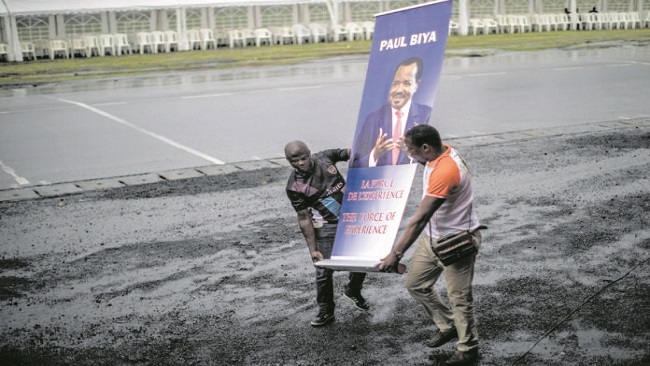
Part of the reason those talks fizzled was the Cameroonian government’s insistence that the ongoing crisis is an issue of terrorism, to be addressed militarily. In 2019, President Paul Biya announced a “Grand National Dialogue” that didn’t even include any separatists and didn’t address key issues, such as whether to revert to a federal form of government that existed prior to 1972.
Subsequently, in January, the government announced a new “Special Status” for the Anglophone regions, which created more regional legislative bodies, among other measures. But this new status did little to change the reality on the ground, and the following months saw widespread violence. Essentially, the Cameroonian government made clear that it was not interested in the separatists’ offers to engage in dialogue and would instead continue with its militaristic approach.
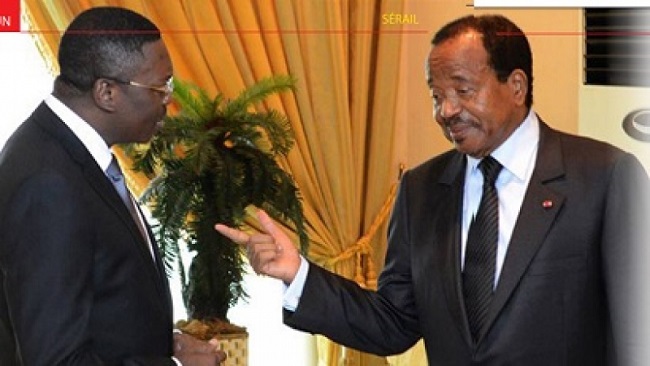
This is why the recent talks between imprisoned separatists and Biya’s government are so noteworthy. The government was represented by officials from the presidency and the office of Prime Minister Joseph Ngute. The separatists were represented by several imprisoned leaders, including Sisiku. Negotiators held two meetings outside the Kondengui Central Prison in Yaounde, the capital, where Sisiku and other political prisoners are being held.
The agenda for the talks centered on what separatists refer to as four action items that would create an enabling environment for further negotiations toward a lasting solution to the conflict. The action items include the demilitarization of the Anglophone regions, with the Cameroonian military being confined to barracks; an amnesty to allow separatists living overseas to return; the release of political prisoners; and a cease-fire that will last until the two sides convene for talks mediated by a third party. The most contentious of these is the release of prisoners, as Sisiku has insisted on a comprehensive release of political prisoners, not an arrangement where the government releases a select group of detainees. Sisiku has also said that if a release occurs in phases, he must be among the last to be released. During the talks, the two sides reached an understanding of the action items.
The talks were initially held in secret, and Sisiku only confirmed them after the second round had concluded. The news was welcomed by multiple separatist leaders and was applauded by civil society groups in Cameroon’s two Anglophone regions, which have long been advocating for a cease-fire. The government, however, did not comment for several days, and even then, its statement downplayed the talks, saying information that government representatives had met with “secessionists awaiting trial is not consistent with reality.”
If hard-liners in the Cameroonian government successfully sabotage the peace process, the costs would be horrific.
To many, this seemed as though the government was denying that the talks had taken place. But in reality, the statement was an indication that not all members of the Cameroonian government are sincere about ending the conflict. In fact, the government is divided into two camps: those advocating for overtures toward separatist leaders, and those seeking to obstruct any negotiated settlement. The first camp consists of Prime Minister Ngute, whose office has spearheaded the talks along with the intelligence chief, Maxime Eko-Eko, who has met with separatist leaders. Gregoire Owona, the minister of labor, and Achille Bassilekin, who is the minister of small and medium sized enterprises, are also in favor of the talks.
On the other side, one of the chief opponents of the talks is Ferdinand Ngoh Ngoh, the powerful secretary-general of the presidency. Other hard-liners in the government include Jacques Fame Ndongo, the minister of higher education, and Paul Atanga Nji, the minister of territorial administration. Notably, the divide does not break down along linguistic lines, as there are Anglophones and Francophones in both camps. Since the talks in July, the latter group appears to have seen success, as there have been no follow-up conversations with the separatists.
Clearly, certain prominent members of Cameroon’s Cabinet are not committed to reaching a lasting political solution to the war that has ravaged the country for nearly four years, with economic and humanitarian implications far beyond its two Anglophone regions. This internal division within the government has only been compounded by tensions about who might succeed the 87-year-old Biya, with both Ngoh Ngoh and Ngute angling for the position. While tensions over succession in Cameroon are not new, in the current environment, they could stymie a real chance to end a needless war.
There are also divisions on the separatist side, with the movement split between two main factions—one led by Sisiku and the other led by Samuel Sako, a former pastor based in the United States, in Maryland. Sisiku is the most influential, with the overwhelming majority of fighters seeing him as the leader of the movement. Even some separatist leaders who do not necessarily support Sisiku’s leadership have indicated that they support his initiative to negotiate with the government.
However, infighting within Biya’s Cabinet and jostling over who will succeed him may prevent the process from advancing. If hard-liners in the Cameroonian government successfully sabotage the peace process, the costs would be horrific: Residents of the Anglophone regions would continue to suffer from violence and human rights violations, as a country that was once known as a beacon of stability in a troubled region will continue to destabilize.
Events in recent weeks have shown that the government is continuing a hard-line approach. In response to the killing of a police officer in the Northwest region, the military banned motorbikes in the provincial capital of Bamenda and launched a military operation to sweep the city. Moreover, on Sept. 17, an appellate court in Yaounde upheld Sisiku’s life sentence on charges of terrorism and secession.
As the Cameroon authorities’ violent response to the peaceful protests that emerged in 2016 showed, the government is capable of starting a war by ignoring legitimate grievances. However, that same government now has the ability to seek an end to it. The only question is whether the hard-liners who have historically had the most influence in the Cabinet will prevent meaningful talks with separatists from advancing.
Culled from World Politics Review






24, September 2020
Human Rights Watch urges Biya regime to stop using COVID-19 and anti-terror law as pretext to quell dissent 0
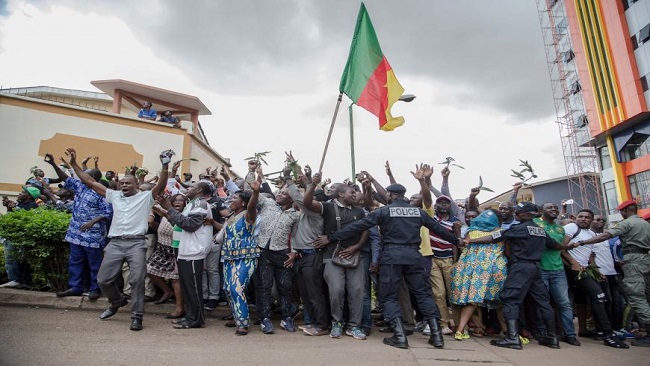
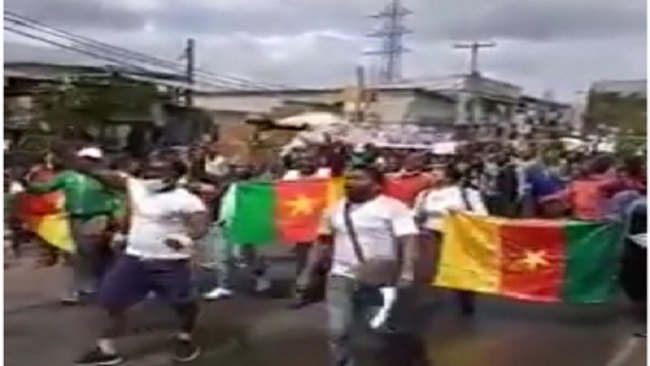
Cameroon authorities banned demonstrations after the opposition party Cameroon Renaissance Movement (Mouvement pour la renaissance du Cameroun, MRC) encouraged people to take to the streets over the government’s decision to call regional elections, Human Rights Watch said on Monday.
On September 11, 2020, the governors of the Littoral and Centre regions banned public meetings and demonstrations indefinitely. Three days later, Territorial Administration Minister Paul Atanga Nji, in a letter to the two governors and the governor of the West region, warned that law enforcement forces would break up unauthorized demonstrations. He said that the governors should arrest anyone organizing or leading demonstrations, claiming that protests would endanger lives during the Covid-19 pandemic. On September 15, the communication minister warned political parties that protests could be considered “insurrection” and that illegal demonstrations across the country would be punished under the anti-terror law.
“These steps are a thinly veiled attempt by the Cameroonian government to use the Covid-19 pandemic and the draconian anti-terror law as a pretext to quell the right to assemble,” said Lewis Mudge, Central Africa director at Human Rights Watch. “Cameroon’s authorities should protect and facilitate the right to assemble, not seek to curb it.”
These measures came after President Paul Biya announced on September 7 that Cameroon’s first regional elections would be in December. On September 8, Maurice Kamto, the MRC leader, called for peaceful protests on September 22 against holding the elections. Seven other opposition parties and civil society organizations have joined Kamto’s call for peaceful demonstrations. Opposition parties have multiple concerns that they cannot be conducted freely and fairly without reforming the electoral code and addressing the lack of security in the Anglophone regions.
Human Rights Watch conducted phone interviews between mid-August and early September with 15 leaders and members of opposition parties, as well as 5 representatives from civil society and human rights groups.
The Cameroonian government started lifting Covid-19 restrictions in May, allowing bars, restaurants, and nightclubs to reopen. In June, it allowed schools and other training centers to reopen, as well as churches and mosques. The efforts to target the opposition-led demonstrations over Covid-19 appear to be arbitrary, Human Rights Watch said. On September 16, the MRC issued a note providing guidance to all members and supporters who are planning to participate on September 22 on how to ensure peaceful demonstrations and curb the spread of Covid-19 by wearing a face mask.
Other opposition-led meetings and demonstrations have been banned in Cameroon in the last 18 months. In April 2019, the authorities banned a week of demonstrations planned by the MRC across the country. Local authorities recently prohibited two private meetings planned by the party in Maroua, Far North region, on August 9, and in Nkongsamba, West region, on August 15, citing concerns around Covid-19 and general public order.
The Nkongsamba meeting was to be a private meeting at the party headquarters and should not have been subject to a public order ban. In Maroua, where the meeting was to be held in a hotel, the local authorities prohibited the meeting ostensibly on health grounds, although party leaders said they were taking preventive measures to avoid the spread of the Covid-19, including respecting the limit of 50 participants, as required by law. Party leaders told Human Rights Watch that authorities have allowed similar meetings in both cities by the governing Cameroon People’s Democratic Movement.
On September 19, the headquarters of the opposition party Cameroon People’s Party (CPP) in Yaoundé was surrounded by over 30 policemen and gendarmes. “The Yaoundé District Officer claimed that the CPP was holding a public meeting without declaration, but we informed him that we were holding our regular weekly meeting whose participation is limited to our members,” Edith Kahbang Walla, known as “Kah Walla,” CPP president said in a statement published the same day. “This is an umpteenth violation of the law and attempt to intimidate us.” After a standoff of about one hour, CPP members were allowed to leave.
Human Rights Watch has previously documented that Cameroon’s government has used the pandemic as a pretext to settle scores and punish the opposition. In May, the authorities arrested several volunteers from the Survival Initiative, Kamto’s fundraising initiative to respond to the health emergency, as they handed out protective masks and sanitizing gel in Yaoundé, the capital. They were charged with rebellion, then released on May 15.
MRC spokesperson Biboun Nissack told Human Rights Watch that the government’s recent ban on demonstrations “threatens to force our party underground.”
Cameroon’s constitution guarantees freedom of assembly. Cameroonian law requires organizers to notify local authorities seven days before a demonstration. While freedom of assembly is not absolute, and restrictions including those aimed at protecting public health are permissible, any such measures must not only have a legal basis but be strictly necessary and proportionate to achieve the objective and not discriminate against particular groups.
Broad, blanket bans such as that invoked by the Cameroon government, in particular in response to political organizing by opposition parties, do not meet these criteria. On March 16, United Nations human rights experts warned that “Emergency declarations based on the Covid-19 outbreak should not function as a cover for repressive action under the guise of protecting health, and should not be used simply to quash dissent.”
The anti-terror law, promulgated in December 2014 as Cameroon struggled to address the escalating threat posed by the Islamist armed group Boko Haram, has been widely criticized, including by Cameroonian and international rights groups and opposition parties, for its overbroad definition of terrorism, the provision of the death penalty, and for being used to silence the opposition, civil society, and the media.
This recent crackdown on freedom of assembly also follows a well-documented pattern of politically motivated arrests and prosecutions of opposition party members and activists, including MRC vice president, Mamadou Mota.
“When government authorities threaten to treat exercise of the right to peaceful protest as an act of insurrection, they are attacking the fundamentals of a society based on human rights and the rule of law,” Mudge said. “Basic freedoms and rights – guaranteed not only under Cameroon’s international obligations, but also in its constitution – are at risk, and if this crackdown leads to wider protests, the excessive use of force and ill-treatment could dramatically escalate.”
Source: Todaynewsafrica