2, February 2018
Kenya court orders government to lift ban on three TV stations 0
Kenya’s High Court has suspended a government blackout imposed on three private television broadcasters over a live coverage of an opposition rally in the capital Nairobi.
Judge Chacha Mwita ordered Thursday that the shutdown imposed on the private stations, namely Kenya Television Network, Citizen Television and Nation Television News, would be suspended for two weeks so that the court could hear a petition by activist Okiya Omtatah Okoiti against the ban.
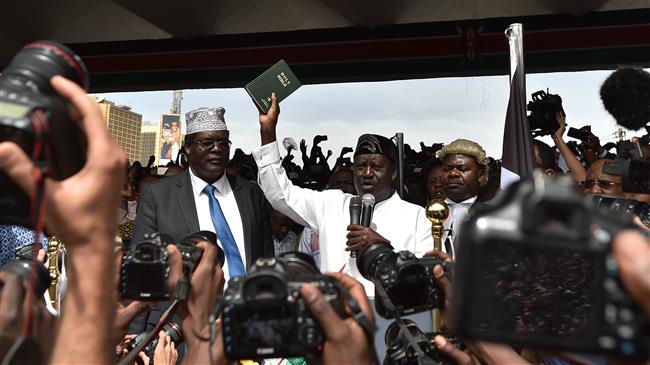
The administration of President Uhuru Kenyatta ordered a shutdown of the TV stations on Tuesday morning after they ran a live coverage of a mock swearing-in ceremony for opposition leader Raila Odinga.
Okoiti described the gag as “grossly arbitrary, disproportionate, oppressive, and unreasonable.”
Kenyatta had reportedly warned heads of the TV stations last Friday that they will be cut off the air if they broadcast the event.

Odinga was sworn in as Kenya’s “people’s president” at a park in Nairobi to the cheers of thousands of supporters. The mock ceremony came in response to Kenyatta’s taking of office for a second time, which the opposition believes was the result of rigged votes.
Odinga refused to accept the results of an initial presidential election last August. He then boycotted a re-run ordered by Kenya’s Supreme Court, claiming irregularities that existed in the first round still persisted. Official government tallies show that around 100 have been killed since the start of vote-related unrest in the Horn of Africa country.
An investigation has been launched into the Tuesday mock swearing-in ceremony which had no sign of violence.
Meanwhile, people on Thursday protested the arrest of Tom Kajwang, a lawyer and opposition lawmaker who administered Odinga’s “oath,” as he was standing a trial over his role in the swearing-in ceremony.
Source: Presstv


















2, February 2018
UK sets up EU row over post-Brexit citizens’ rights 0
UK Prime Minister Theresa May says European Union citizens arriving in Britain during its post-Brexit transition period should not be afforded the same rights as those who arrived earlier.
The embattled premier appears set for a clash with EU negotiators after telling reporters on a trip to China that “there is a difference between those who came prior to us leaving and those who will come when they know the UK is leaving.”
She added that the status of such EU citizens would be “a matter for negotiation” when Britain meets with EU officials again in March to set the terms of the transition period, which is expected to last around two years after Britain officially exits the bloc in March 2019.
Brussels on Monday warned London that “citizens’ rights during the transition are not negotiable.”
The European Parliament’s chief Brexit negotiator Guy Verhofstadt said that “for the transition to work” there could not be “two sets of rights for EU citizens.”
That would mean the continuation of free movement and citizens’ rights for EU nationals residing in the UK during the Brexit transition, an arrangement that would cause anger among pro-Brexit lawmakers and ministers within May’s Conservative Party.
Deputy Brexit Secretary Robin Walker on Thursday insisted that Britain would not accept such an agreement.
“The citizens’ rights agreement reached in December does give certainty about the rights of EU citizens already here going forward but this agreement does not cover those who are arriving after we leave the EU,” he told Members of Parliament (MPs) in the House of Commons.
The EU and UK negotiated an agreement in December that safeguards the rights of EU citizens who arrive in Britain before it leaves the bloc next year, giving reciprocal protections for British citizens living in the EU.
The agreement allows those who have lived continuously in Britain for five years to be able to apply for settled status, while others will be able to remain in order to build-up five years’ continuous residence.
The British government has faced fierce criticism both at home and by the EU for its lack of clarity on its Brexit strategy.
The uncertainty has raised fears that Britain could crash out of the bloc without a trade deal, incurring heavy costs on domestic economy.
Source: Presstv