2, July 2021
Maurice Kamto denied entry to France 0
French authorities have rejected Cameroonian opposition leader Maurice Kamto’s visa application to attend a literary event near Paris.
Source: Africa Intelligence

2, July 2021
French authorities have rejected Cameroonian opposition leader Maurice Kamto’s visa application to attend a literary event near Paris.
Source: Africa Intelligence

2, July 2021
The round of 16, which included two epic matches that went into extra time, ended on June 29. We now know who the eight quarter-finalists are – and world champions France are not among them.
It’s time for the Euro 2021 quarter-finals. While the round of 16 saw several favourites lose in shock defeats – France, Portugal and the Netherlands are all on their way home –eight teams remain in the running.
Belgium and Italy will be the big match of the final eight, while Switzerland will face Spain earlier on the same day. On Saturday, the Czech Republic will play against Denmark. The last knockout match will see England pitted against Ukraine.
Full schedule for the Euro 2021 quarter-finals
Friday 2 July:
Switzerland vs Spain, 6pm in St Petersburg.
Belgium vs Italy, 9pm in Munich.
Saturday 3 July:
Czech Republic vs Denmark, 6pm in Baku.
Ukraine vs England, 9pm in Rome.
Culled from France 24

2, July 2021
The Southern Cameroons Secretary of the Economy, Hon. Tabenyang Brado has insisted that the Abuja abduction and subsequent arrest of President Sisiku Ayuk Tabe and his top aides was totally wrong and that the Biya Francophone regime is now facing its last journey of many dangers in Southern Cameroons-Ambazonia.
Hon. Tabenyang told Cameroon Concord News US Bureau Chief that ever since the arrest of President Sisiku Ayuk Tabe, political and economic relations with La Republique du Cameroun are no longer possible.
“It was not only wrong but it was also very dangerous for the security interests of the two Cameroons,” Hon. Tabenyang added.
The Southern Cameroons front line leader also thanked Vice President Dabney Yerima for stabilizing and uniting the Ambazonia Restoration Forces with the Big Rubbergun Project saying, “We need unity and great leaders like Yerima to get to Buea.”
The power dynamics are no longer in favor of Cameroon government forces. In Southern Cameroons, the massive jungles and wide savannas is providing coverage for the determined fighters and they are making the most of this natural advantage. Those who doubted the determination and courage of these fighters had to think twice before expressing their views, especially as the number of body bags heading to French Cameroun is increasing by the day.
Our chief political man, Soter Tarh Agbaw-Ebai opined that “The tell-tale signs of a political and military miscalculation had begun appearing on the government’s dashboard.
The fighting that started with hunting rifles has now seen AK-47s thrown in the mix and their presence has been a long nightmare to the Cameroon government military. These dangerous Russian-made war machines have cut short the lives of many soldiers, sending their families into long periods of mourning. Many are already questioning the rationale behind the fighting.
But the fighters are not yet done. They still have unfinished business. The Federal Republic of Ambazonia is not yet independent.
By Isong Asu with files from Camcordnews US Bureau
2, July 2021
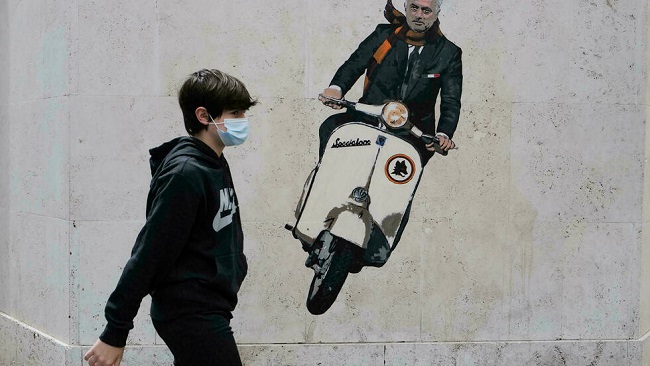
Jose Mourinho’s era as Roma coach is set to begin with the Portuguese due to touch down in the Italian capital on Friday.
“AS Roma fans I’m about to pack my bags. See you soon,” Mourinho said in a video posted in English and Italian by the club on social media.
Mourinho is expected to arrive in the city in the afternoon.
The 58-year-old returns to Italy, where he left as a hero back in 2010 after leading Inter Milan to the treble — Champions League, Serie A and Coppa Italia.
Mourinho had only been out of work for 15 days after leaving Tottenham two months ago before his return to Serie A was announced on a three-year deal.
His departure from Spurs marked the first time since the early years of his managerial career in Portugal that the self-declared ‘Special One’ left a club without winning any silverware.
Mourinho has claimed 25 major trophies in his career and joins a club that hasn’t won Serie A since 2001.
As well as his triumphs with Inter he won the Champions League in 2004 and two Portuguese league titles with Porto, three Premier League titles with Chelsea and La Liga with Real Madrid in 2012.
He also led Manchester United to the Europa League in 2017.
In Rome, he replaces fellow Portuguese Paulo Fonseca who left the club after two seasons.
The three-time Italian champions, who are trophyless since 2008, finished seventh in Serie A last season.
Fonseca replaced Claudio Ranieri, who had a brief spell as coach after Eusebio Di Francesco was sacked in January 2019.
Di Francesco had guided the club to the Champions League semi-finals in 2018.
Source: AFP
2, July 2021
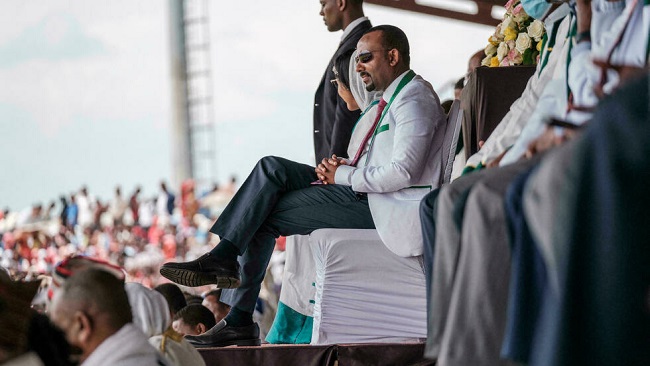
The surprise fall of the Tigrayan regional capital, Mekelle, this week has put Ethiopian Prime Minister Abiy Ahmed in a tough spot, dealt a blow to the country’s military and placed the Tigrayan forces in a position of strength.
Ethiopian Prime Minister Abiy Ahmed may have won a Nobel Peace Prize, but on Monday, June 28, he seemed unable to grasp the difference between war and peace, ceasefire and defeat, and – more critically – the distinction between spin and the hard realities on the ground.
The disconnect has threatened not just Abiy’s credibility, but the security of his country, the wider Horn of Africa region, and exposed the challenges confronting the African Union – based in the Ethiopian capital, Addis Ababa – in its bid to deliver “African solutions to African problems”.
On Monday evening, reports started emerging from Mekelle, capital of war-ravaged northern Tigray province, that Ethiopian troops were suddenly withdrawing from the city. Before long, crowds gathered in Mekelle’s streets to celebrate the departure of Ethiopian government forces and welcome the arrival of Tigray Defense Forces (TDF) rebel fighters.
The Abiy administration, however, had an unusual spin on the latest development in the devastating eight-month-long Tigray conflict. The government had declared an “unconditional, unilateral ceasefire” in the province, according to a statement published by state media.
Tigrayan leaders offered a different narrative.
In a statement released Monday night, Tigrayan leaders asserted that Mekelle’s fall was due to a “lightning operation” by the Tigray Defense Forces, a rebel army composed of members of the region’s former ruling party, the Tigray People’s Liberation Front (TPLF) as well as non-members. The TDF was formed shortly after Abiy ordered a military operation on Tigray in November 2020, and this was their “victory” against “the invading forces”, the statement proclaimed.
“It’s clearly, without a doubt, a military defeat. You can’t have a situation where one party declares a unilateral ceasefire while fleeing areas it once controlled. They could have at least said they retreated for tactical reasons,” said Awol Allo, senior lecturer at Keele University in England.
Days later, the official narrative was starting to unwind and the ceasefire was in doubt.
“If it is required, we can easily enter Mekelle and we can enter in less than three weeks,” Redwan Hussein, spokesman for the Ethiopian government’s task force for Tigray, told reporters in Addis Ababa on Wednesday.
Abiy, meanwhile, acknowledged that government troops had left Mekelle, and that his army units had been ambushed and “massacred” while advancing through Tigrayan villages. But he attempted to downplay the fall of the Tigrayan regional capital, insisting it was not a defeat.
“It was the centre of a government. A centre for known and unknown resources. But by the time we exit, there is nothing special about it except that there are some 80,000 people, and those who loot people,” said Abiy in a videotaped address posted on his website, vastly underestimating the city’s population of around 500,000, according to demographers.
‘Monumental fall from grace’
From a globally fêted peacemaker to hawk overseeing a conflict that has seen mass killings, displacements and allegations of serious human rights violations by the UN, Abiy’s international stature has taken a sharp nosedive over the past eight months.
“For Abiy, it’s such a monumental fall from grace. This is somebody who came to power on the back of widespread popular protests. He was popular, his team was popular, and he received extensive international praise for establishing friendship with the Eritrean dictator,” said Awol, referring to the 2018 peace deal signed by Abiy and Eritrean President Isaias Afwerki.
Awol – who was among the experts who nominated the Ethiopian prime minister for the 2019 Nobel Peace Prize – believes Abiy’s credibility began to slide with his attempts to “consolidate power and enact his childhood ambitions on 100 million inhabitants of Ethiopia”.
Abiy’s rise from rural poverty to the country’s highest office is by now the stuff of legend in Ethiopia, a rags-to-riches tale that acquires a messianic quality with every retelling. As recounted in a 2018 interview with the New York Times, the story goes that his impoverished mother once whispered into the ear of a 7-year-old Abiy that he would “end up in the palace” and “serve the nation”.
Critics, however, question whether Abiy, now 44, is best serving his country and its military, the Ethiopian National Defense Force (ENDF).
“This is a military that has a reputation for being tough. Unfortunately, with this particular defeat of a big national force being repulsed by a tiny region, the Ethiopian military no longer has the same standing,” said Awol.
Rebel ‘mastermind’ rises from forced retirement
The Ethiopian military’s loss of stature has been the TDF’s gain.
On November 4, 2020, when the Ethiopian prime minister ordered a military operation in Tigray following escalating tensions with his former coalition partner, the TPLF, military experts immediately warned of a tough fight between “battle-hardened” troops.
With a combined force of around 140,000 active personnel, mostly in the army, the ENDF is considered a military heavyweight in the Horn of Africa region, one that has conducted cross-borders campaigns in neighbouring Eritrea and Somalia, and has been the backbone of the UN-backed African Union Mission in Somalia (AMISOM).
But the northern Tigray province – with its well-armed regional paramilitary force led by former national army generals – could also put up a fierce resistance, analysts warned.
That resistance strengthened as Abiy’s controversial use of Eritrean troops and militias from the rival ethnic Amhara group united Tigrayans, including those who had fallen out with the TPLF.
Formed in the 1970s, the TPLF emerged as the biggest and most powerful armed rebel group in Ethiopia following the 1991 ouster of brutal dictator Mengistu Hailemariam. The party then dominated Ethiopian politics for over two decades, overseeing economic development in the impoverished nation, but also maintaining power through repression.
The TPLF’s excesses sparked several splits within the ranks, including a particularly acrimonious one in 2001, following the end of the end of Eritrea-Ethiopia war.
One of the casualties of the internal TPLF splits was Gen. Tsadkan Gebretensae, considered one of Ethiopia’s finest military strategists, who was fired from his post as Ethiopia’s chief of general staff.
When Abiy launched a military offensive in Tigray, Gen. Tsadkan was among several former TPLF senior military officers who joined the freshly minted TDF.
“The TPLF is a party with a contested legacy because it brutalised the Ethiopian public for nearly a quarter of a century,” explained Awol. So when the TDF emerged out of the TPLF last year, it attracted “all the Tigrayans who disagreed with the TPLF in the past and who saw no reason to reject the TDF,” he explained.
Gen. Tsadkan immediately assumed joint responsibility for the TDF’s military affairs, and spent months training new recruits before the latest offensive was launched, wrote leading Africa analyst Alex de Waal in a BBC column. Following the spectacular fall of Mekelle, the retired army general is being hailed as the Tigrayan “mastermind” in a recruiting coup for the TDF.
No African solution for this African problem
Ethiopia’s decommissioning of senior Tigrayan military commanders raised eyebrows in November, when the AU fired its security chief a day after the bloc’s chair, Moussa Faki Mahamat, received a letter from the Ethiopian defense ministry requesting the Tigrayan general’s dismissal, according to Reuters.
Gen. Gebreegziabher Mebratu Melese was on a list of military officials accused of treason for belonging to the TPLF “junta”.
Headquartered in Addis Ababa, the AU has faced criticisms over its inability to intervene in a conflict that has killed thousands of people, displaced over a million and has plunged the area to the brink of a humanitarian disaster, according to the UN.
“I think the AU’s credibility is in tatters, its prestige has been undermined by its failure to tackle the issue or even table a resolution on the Tigrayan crisis. There is a widespread belief among Tigrayans that the AU simply followed the Ethiopian government’s talking points,” said Awol.
Following a call by US Secretary of State Antony Blinken for the AU to do more to address the crisis, the bloc launched a commission in June to investigate alleged human rights violations in Tigray.
But like the UN, the AU is limited by the interests and actions of its member states, a fact underscored by the Ethiopian government’s call on the bloc to “immediately cease” the human rights commission leading the inquiry.
Eritrean troops, Amhara militias ‘sandwich Tigray’
The most serious implications of Abiy’s use of military force in Tigray, however, concern the future security and stability of his own ethnically diverse nation.
The Ethiopian prime minister’s use of Eritrean troops – which was officially denied as “fake news” for months – in northern Tigray and of Amhara militias in the southern and western regions was part of a “sandwich Tigray” strategy to isolate the recalcitrant province, according to analysts.
But by turning one ethnic group against another and inviting the involvement of a neighbouring country that has long been an enemy of the Ethiopian state, Abiy has played with fire. Those flames could engulf the nation and the region.
Traditionally, ceasefire declarations are welcomed as opportunities to try to bring warring camps to the table. But the Ethiopian government’s so-called ceasefire could spark an intensification of the conflict, many analysts warn.
“It’s difficult to bring the two parties to the table,” Awol explained. “Abiy invited the enemy country, Eritrea, and that’s really hard to reconcile. Barbaric crimes were committed, there’s been a polarisation of the populace and hatred fueled by propaganda. I find it very hard to see how the country can move on.”
On the domestic front, the Amhara “elites” have long contested pieces of territory in what is now Tigray province, particularly the Benishangul-Gumuz region near the eastern border with Sudan, where the massive Grand Renaissance Dam is under construction.
Politically sidelined in recent years, the Amharas nevertheless consider themselves the country’s cultural elites. Critics say Abiy has stoked Amhara nationalism, including frequent references to Menelik I, the first Solomonic emperor of Ethiopia who is believed to be the ancestor of the last emperor, Haile Selassie.
The rise in the TDF’s military fortunes are a troubling development for the Amhara militias, noted Awol. “The biggest losers could be the Amharas because the Ethiopian National Defense Forces have left. Will Abiy now defend the areas the Amharas have taken and now control? There will be military, economic and ideological problems ahead,” he warned.
The only hope, according to Awol, is for the international community, specifically the Western powers, to bring the two sides to the negotiating table. But the seasoned Ethiopian analyst is not putting any bets on a peaceful outcome in the short term.
“This defeat puts the government, that until recently resisted any suggestion of peaceful negotiations, in a very weak position. If there are any negotiations, the TPLF will be negotiating from a position of strength,” Awol noted.
It’s a position Ethiopia’s Nobel laureate leader is unlikely to accept in the spirit of peace.
Source: France 24
1, July 2021
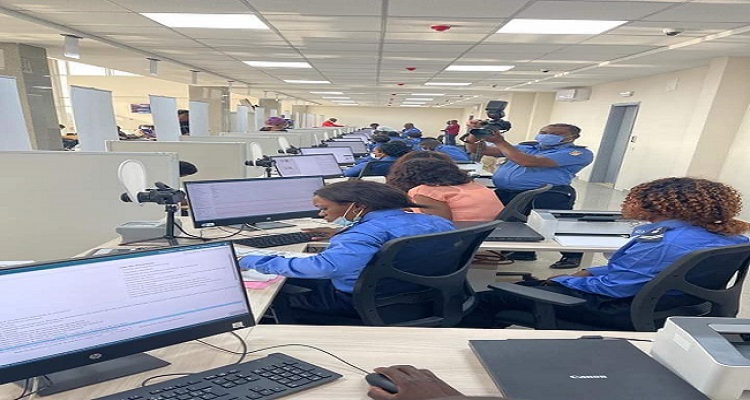
Cameroon has come up with a massive and modern digital passport production office, but old habits will always die hard.
The new digital system is designed to help reduce frustration and the corrupt practices that characterized the old system.
The old system provided a platform for self-enrichment to corrupt police officers who never hesitated to extort money from the helpless public.
Over the last two years, obtaining a passport in Cameroon has been a lot tougher than going through the eye of a needle, with passport officials asking for close to USD 1,000 for a passport, especially if the passport applicant was in a rush.
For those who wanted to go through the normal process, the issuing of an ordinary passport could take up to a year if the “Lords of the Universe” were in the right mood to do their job.
Cameroon is a country where there are no checks and balances. It is a country wherein a police officer can cook up a story and lock you up for years and this has struck fear in the minds of most French-speaking Cameroonians.
The country has no recourse mechanism and if they do exist, the objective is always to please the gullible international community that has been dumping money on the country, hoping that the country’s numerous and complicated issues could be addressed by throwing huge chunks of money at them.
The reckless behaviour is indeed the hallmark of the country’s passport production office. A police officer has the prerogative of charging the country’s citizens hundreds of dollars for just a passport and when those passports get produced, the frustrated citizens have no way of knowing that their documents have been issued.
This is what centralization can do to a country. But if you think that is the worst scenario, just take a trip to the old passport office and you will find a mountain of unclaimed passports just sitting outside the office and nobody really cares. The interest of the citizens is never paramount.
This is even a great sight to behold by the country’s standards. In certain circumstances, a drunken or angry police officer could scoop a bunch of passports and dispose of them at the nearest garbage bin and nobody will ask any questions.
This is the country of great ambitions and emergence. Like a friend said, Cameroon seems to be emerging into unprecedented chaos which is being ignored by the country’s authorities and tolerated by the citizens who do not know where to take their anger and frustration to.
The new passport office is designed to be a panacea for all the headaches that characterized the old office, but not many Cameroonians are hopeful. The government has been selling illusions for decades and many desperate citizens hold that their beloved government might simply be repackaging and old lie to sell it to its citizens.
No government in the world knows how to beautify a lie. This is a government that can put lipstick and mascara on a pig and sell it to the public, claiming that the pig is the most beautiful girl in town.
For more than four years, the country has been dealing with a bloody civil war, with the country’s English-speaking minority seeking to walk away from a hastily put together union.
In response to the demands of the English-speaking minority, the government has been claiming that only decentralization can address the core issues that are splitting the country.
To deceive the international community, an ill-planned national “monologue” was organized, with members of the country’s ruling crime syndicate known as the CPDM taking decisions that will only help them perpetuate their stay in power.
At the end of the day, their decentralization agenda was upheld and promoted. They added something new to their Machiavellian plan, calling it Special Status which was nothing but a scheme designed to hoodwink the English-speaking minority into abandoning their plan to walk away from the lopsided union called the United Republic of Cameroon.
From every indication, the Yaoundé government has been paying lip service to the whole notion of decentralization and the strong centralization of the country’s passport issuing process in Yaoundé is just a reminder to the English-speaking regions of the country that their hope for a better life in Cameroon will never be a reality.
If decentralization is what the government has been selling all these years, what then has gone wrong with the decentralization of the passport production process?
Does this imply that someone living in Mamfe and needs an urgent passport, will be heading to Yaoundé to face the uniformed crooks who have made life unbearable to the ordinary Cameroonian?
What happened to Buea which is a lot closer to Mamfe than Yaoundé? When will the Yaoundé government understand that little actions and acts can go a long in calming down flaring anger?
Old habits really die hard and the Yaoundé government which is made up of “living ancestors” and is used to old ways will surely not be embracing new ways anytime soon.
If Cameroonians think they will one day know an easy life in their own country, then they must act differently.
Their leaders are not going to embrace new ways and they do not care if their out-dated ways are killing every Cameroonian.
The country’s leaders see themselves as the new colonial masters and they will stop at nothing to ensure their citizens go through excruciating physical and psychological pain.
By Soter Tarh Agbaw-Ebai
1, July 2021
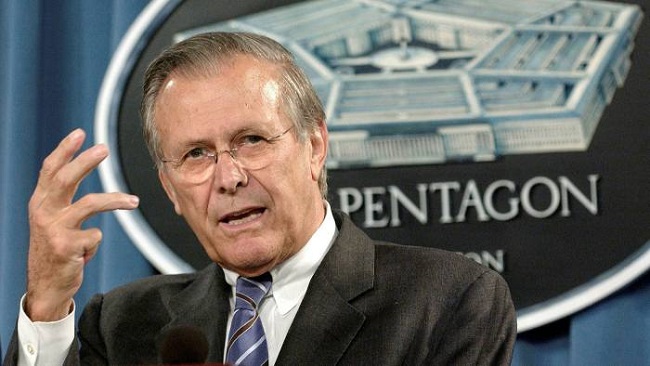
Donald Rumsfeld, a forceful U.S. defence secretary who was the main architect of the Iraq war until President George W. Bush replaced him when the United States found itself bogged down after three years of fighting, has died at age 88, his family said in a statement on Wednesday.
“It is with deep sadness that we share the news of the passing of Donald Rumsfeld, an American statesman and devoted husband, father, grandfather and great grandfather,” the statement said. “At 88, he was surrounded by family in his beloved Taos, New Mexico.”
The statement did not say when Rumsfeld died.
Rumsfeld, who ranks with Vietnam War-era defense secretary Robert McNamara as the most powerful men to hold the post, brought charisma and bombast to the Pentagon job, projecting the Bush administration’s muscular approach to world affairs.
With Rumsfeld in charge, U.S. forces swiftly toppled Iraqi President Saddam Hussein but failed to maintain law and order in the aftermath, and Iraq descended into chaos with a bloody insurgency and violence between Sunni and Shi’ite Muslims. U.S. troops remained in Iraq until 2011, long after he left his post.
Rumsfeld played a leading role ahead of the war in making the case to the world for the March 2003 invasion. He warned of the dangers of Iraqi weapons of mass destruction but no such weapons were ever discovered.
Only McNamara served as defence secretary for longer than Rumsfeld, who had two stints – from 1975 to 1977 under President Gerald Ford, for whom he also served as White House chief of staff, and from 2001 to 2006 under Bush.
Rumsfeld was known for imperious treatment of some military officers and members of Congress and infighting with other members of the Bush team, including Secretary of State Colin Powell. He also alienated U.S. allies in Europe.
In 2004, Bush twice refused to accept Rumsfeld’s offer to resign after photos surfaced of U.S. personnel abusing prisoners at the Abu Ghraib prison outside Baghdad. The scandal triggered international condemnation of the United States.
The United States faced global condemnation after the photos showed U.S. troops smiling, laughing and giving thumbs up as prisoners were forced into sexually abusive and humiliating positions including a naked human pyramid and simulated sex. One photo showed a prisoner forced to stand on a small box, his head covered in a black hood, with wires attached to his body.
Lightning rod for criticism
Rumsfeld personally authorized harsh interrogation techniques for detainees. The U.S. treatment of detainees in Iraq and foreign terrorism suspects at a special prison set up under Rumsfeld at the U.S. naval base at Guantanamo Bay, Cuba, drew international condemnation, with human rights activists and others saying prisoners were tortured.
He was a close ally of Bush’s vice president, Dick Cheney, who had worked for Rumsfeld during the 1970s Republican presidencies of Richard Nixon and Ford.
Rumsfeld became a lightning rod for criticism and, with the Iraq war largely a stalemate and public support eroding, Bush replaced him in November 2006 over Cheney’s objections.
Days after vowing Rumsfeld would remain for the rest of his term, Bush announced his departure a day after mid-term elections in which Democrats took control of Congress from Bush’s Republicans amid voter anger over the Iraq War.
Robert Gates, a soft-spoken but demanding former CIA director, took over from Rumsfeld in December 2006 and made sweeping strategic and military leadership changes in Iraq.
Many historians and military experts blamed Rumsfeld for decisions that led to difficulties in Iraq. For example, Rumsfeld insisted on a relatively small invasion force, rejecting the views of many generals. The force was then insufficient to stabilize Iraq when Saddam fell.
Rumsfeld also was accused of being slow to recognize the emergence of the insurgency in 2003 and the threat it posed.
The U.S. occupation leader under Rumsfeld, L. Paul Bremer, quickly made two fateful decisions. One dissolved the Iraqi military, putting thousands of armed men on the streets rather than harnessing Iraqi soldiers as a reconstruction force as originally planned.
The second barred from Iraq’s government even junior members of the former ruling Baath Party, essentially emptying the various ministries of the people who made the government operate.
Afghanistan invasion
Rumsfeld also oversaw the U.S. invasion of Afghanistan in 2001 to oust the Taliban leaders who had harbored the al Qaeda leaders responsible for the Sept. 11 attacks on the United States. As he did in Iraq two years later, Rumsfeld sent a small force to Afghanistan, quickly chased the Taliban from power and then failed to establish law and order.
U.S. forces during Rumsfeld’s tenure also were unable to track down Osama bin Laden. The al Qaeda chief slipped past a modest force of U.S. special operations troops and CIA officers along with allied Afghan fighters in the Afghan mountains of Tora Bora in December 2001. U.S. forces killed him in 2011.
Critics argue that had Rumsfeld devoted more troops to the Afghan effort, bin Laden may have been taken. But as he wrote in “Rumsfeld’s Rules,” his compilation of truisms dating to the 1970s: “If you are not criticized, you may not be doing much.”
Another quote from “Rumsfeld’s Rules” was equally apt: “It is easier to get into something than to get out of it.”
Rumsfeld was known for his rollicking news conferences in which he sparred with reporters and offered memorable quotes.
Speaking in 2002 about whether Iraq would give weapons of mass destruction to terrorists, he said: “Reports that say that something hasn’t happened are always interesting to me, because as we know, there are known knowns. There are things we know we know. We also know there are known unknowns. That is to say we know there are some things we do not know. But there are also unknown unknowns – the ones we don’t know we don’t know.”
Rumsfeld later titled his memoir “Known and Unknown.”
“Stuff happens,” he told reporters in April 2003 amid rampant lawlessness in Baghdad after U.S. troops captured the Iraqi capital.
During his time away from public service, Rumsfeld became wealthy as a successful businessman, serving as chief executive of two Fortune 500 companies. In 1988, he briefly ran for the Republican U.S. presidential nomination.
Rumsfeld also served as a Navy pilot, U.S. NATO ambassador and was elected to the U.S. House of Representatives. He and wife Joyce had three children.
(REUTERS)

1, July 2021
Top leaders of the Southern Cameroons struggle have reportedly exchanged views on the latest Ambazonia gains against the Cameroon government military and ways to achieve ultimate victory against the Biya French Cameroun occupying regime.
En route to Brussels on Tuesday for a meeting on the latest developments related to the war in Southern Cameroons, the Vice President of the Ambazonia Interim Government Dabney Yerima had a telephone conversation with the Ambazonia Intelligence Chief in Ground Zero.
Cameroon Concord News gathered that during the conversation, the two front line leaders spoke frankly on the situation in Bui and Otu in Eyumojock and its repercussions on the Biya Francophone regime in Yaoundé.
Southern Cameroons Self Defense Groups based in Ground Zero launched a counter offensive following heavy deployment of Cameroon government troops to Bui and Otu in Eyumojock. Soldiers loyal to the Biya Francophone regime turned a deaf ear an earlier ultimatum from the Ambazonia Interim Government and kept assaulting innocent Southern Cameroons civilians.
The Southern Cameroons was one of the territories set for decolonization in the context of the UN decolonization agenda. Britain’s devious handling of it and the British wheeling and dealing at the UN in 1959 and 1960 caused a great historical injustice to the people of the Southern Cameroons. That injustice continues to cry out for redress. British action resulted in the unconscionable imposition of an unnecessary and precipitated plebiscite with dead-end alternatives. Speaking through Lord Perth, Britain shamefully said the Southern Cameroons and its people were “expendable”.
The plebiscite was imposed in the teeth of opposition by the leadership of the trust territory. It offered a Hobson’s choice of ‘joining’ either Nigeria or French Cameroun. The internationally-prescribed political status option of sovereign independence was deliberately excluded. There was no good reason for doing so. On 11 February 1961, a skewed plebiscite was foisted on the people of the Southern Cameroons. Faced with the Hobson’s ‘choice’ that was forced down their throat, the people opted for independence in political association with Republique du Cameroun. It was agreed in writing between the two countries and to the knowledge of Britain and the UN, that the political association would take the form of an aggregative federation of two states, equal in status.
In 1972 Republique du Cameroun despotically ended the subterfuge of a federation and formerly annexed the territory of the Southern Cameroons as part of its territory. The Government of the Southern Cameroons was dismissed and its parliament dissolved along with the police and the public service of the federated state. All property, including artefacts, official documents and other archives, belonging to the Government of the Southern Cameroons was vandalized, destroyed in situ or carted to Yaoundé and simply burnt to ashes. The reason for this barbarianism was to erase any memory of the Southern Cameroons as a congener of statehood. Republique du Cameroun however continued to camouflage it’s predatory and expansionist politics under the cloak of what it instituted as so-called ‘United Republic of Cameroun’.
By Chi Prudence Asong

1, July 2021
Cameroon has issued a EUR685 million ($812.20 million) eurobond with 5.95% coupon, proceeds from which will help refinance a 2015 eurobond, the finance ministry said in a statement.
The bond, with an 11-year maturity, was oversubscribed, with an orderbook of EUR2.258 billion, it said.
($1 = 0.8434 euros)
Source: Reuters
 4 Anglophone detainees killed in Yaounde
 Chantal Biya says she will return to Cameroon if General Ivo Yenwo, Martin Belinga Eboutou and Ferdinand Ngoh Ngoh are sacked
 The Anglophone Problem – When Facts don’t Lie
 Anglophone Nationalism: Barrister Eyambe says “hidden plans are at work”
 Largest wave of arrest by BIR in Bamenda






2, July 2021
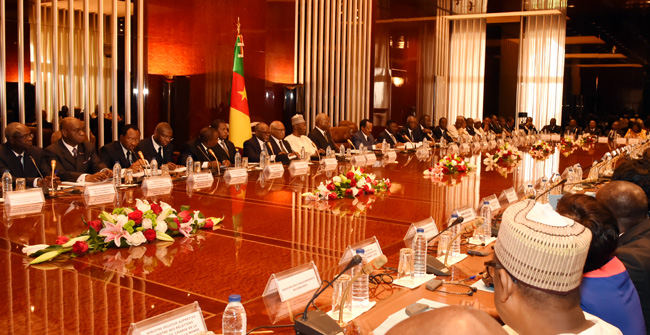
After Biya-Dangote Meeting: CPDM Crime Syndicate threatens CIMENCAM with closure over prices rises 0
Luc Magloire, the Minister of Commerce, has written to Cimenteries du Cameroun (CIMENCAM) threatening to close its production facilities if it raises its prices without approval. In the letter the minister accused the subsidiary of LafargeHolcim of increasing its wholesale prices and of preparing to do so again without consent, according to the Ecofin Agency. Prices have reportedly risen by up to 8% in some places.
Friction occurred between the government and CIMENCAM in 2020 when LafargeHolcim renewed the term of Benoît Galichet as the chief executive officer of its local subsidiary. The government, a large minority shareholder of the company, opposed the decision. The government and the cement producer have also disagreed previously over the price of cement.
Source: Global Cement News