1, July 2021
US: Donald Rumsfeld, defence secretary under George W Bush, dies at 88 0
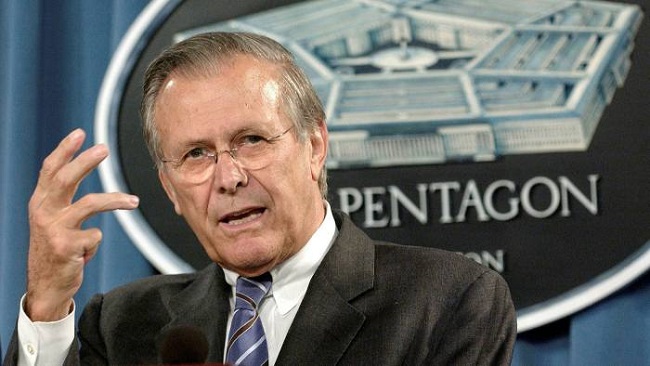
Donald Rumsfeld, a forceful U.S. defence secretary who was the main architect of the Iraq war until President George W. Bush replaced him when the United States found itself bogged down after three years of fighting, has died at age 88, his family said in a statement on Wednesday.
“It is with deep sadness that we share the news of the passing of Donald Rumsfeld, an American statesman and devoted husband, father, grandfather and great grandfather,” the statement said. “At 88, he was surrounded by family in his beloved Taos, New Mexico.”
The statement did not say when Rumsfeld died.
Rumsfeld, who ranks with Vietnam War-era defense secretary Robert McNamara as the most powerful men to hold the post, brought charisma and bombast to the Pentagon job, projecting the Bush administration’s muscular approach to world affairs.
With Rumsfeld in charge, U.S. forces swiftly toppled Iraqi President Saddam Hussein but failed to maintain law and order in the aftermath, and Iraq descended into chaos with a bloody insurgency and violence between Sunni and Shi’ite Muslims. U.S. troops remained in Iraq until 2011, long after he left his post.
Rumsfeld played a leading role ahead of the war in making the case to the world for the March 2003 invasion. He warned of the dangers of Iraqi weapons of mass destruction but no such weapons were ever discovered.
Only McNamara served as defence secretary for longer than Rumsfeld, who had two stints – from 1975 to 1977 under President Gerald Ford, for whom he also served as White House chief of staff, and from 2001 to 2006 under Bush.
Rumsfeld was known for imperious treatment of some military officers and members of Congress and infighting with other members of the Bush team, including Secretary of State Colin Powell. He also alienated U.S. allies in Europe.
In 2004, Bush twice refused to accept Rumsfeld’s offer to resign after photos surfaced of U.S. personnel abusing prisoners at the Abu Ghraib prison outside Baghdad. The scandal triggered international condemnation of the United States.
The United States faced global condemnation after the photos showed U.S. troops smiling, laughing and giving thumbs up as prisoners were forced into sexually abusive and humiliating positions including a naked human pyramid and simulated sex. One photo showed a prisoner forced to stand on a small box, his head covered in a black hood, with wires attached to his body.
Lightning rod for criticism
Rumsfeld personally authorized harsh interrogation techniques for detainees. The U.S. treatment of detainees in Iraq and foreign terrorism suspects at a special prison set up under Rumsfeld at the U.S. naval base at Guantanamo Bay, Cuba, drew international condemnation, with human rights activists and others saying prisoners were tortured.
He was a close ally of Bush’s vice president, Dick Cheney, who had worked for Rumsfeld during the 1970s Republican presidencies of Richard Nixon and Ford.
Rumsfeld became a lightning rod for criticism and, with the Iraq war largely a stalemate and public support eroding, Bush replaced him in November 2006 over Cheney’s objections.
Days after vowing Rumsfeld would remain for the rest of his term, Bush announced his departure a day after mid-term elections in which Democrats took control of Congress from Bush’s Republicans amid voter anger over the Iraq War.
Robert Gates, a soft-spoken but demanding former CIA director, took over from Rumsfeld in December 2006 and made sweeping strategic and military leadership changes in Iraq.
Many historians and military experts blamed Rumsfeld for decisions that led to difficulties in Iraq. For example, Rumsfeld insisted on a relatively small invasion force, rejecting the views of many generals. The force was then insufficient to stabilize Iraq when Saddam fell.
Rumsfeld also was accused of being slow to recognize the emergence of the insurgency in 2003 and the threat it posed.
The U.S. occupation leader under Rumsfeld, L. Paul Bremer, quickly made two fateful decisions. One dissolved the Iraqi military, putting thousands of armed men on the streets rather than harnessing Iraqi soldiers as a reconstruction force as originally planned.
The second barred from Iraq’s government even junior members of the former ruling Baath Party, essentially emptying the various ministries of the people who made the government operate.
Afghanistan invasion
Rumsfeld also oversaw the U.S. invasion of Afghanistan in 2001 to oust the Taliban leaders who had harbored the al Qaeda leaders responsible for the Sept. 11 attacks on the United States. As he did in Iraq two years later, Rumsfeld sent a small force to Afghanistan, quickly chased the Taliban from power and then failed to establish law and order.
U.S. forces during Rumsfeld’s tenure also were unable to track down Osama bin Laden. The al Qaeda chief slipped past a modest force of U.S. special operations troops and CIA officers along with allied Afghan fighters in the Afghan mountains of Tora Bora in December 2001. U.S. forces killed him in 2011.
Critics argue that had Rumsfeld devoted more troops to the Afghan effort, bin Laden may have been taken. But as he wrote in “Rumsfeld’s Rules,” his compilation of truisms dating to the 1970s: “If you are not criticized, you may not be doing much.”
Another quote from “Rumsfeld’s Rules” was equally apt: “It is easier to get into something than to get out of it.”
Rumsfeld was known for his rollicking news conferences in which he sparred with reporters and offered memorable quotes.
Speaking in 2002 about whether Iraq would give weapons of mass destruction to terrorists, he said: “Reports that say that something hasn’t happened are always interesting to me, because as we know, there are known knowns. There are things we know we know. We also know there are known unknowns. That is to say we know there are some things we do not know. But there are also unknown unknowns – the ones we don’t know we don’t know.”
Rumsfeld later titled his memoir “Known and Unknown.”
“Stuff happens,” he told reporters in April 2003 amid rampant lawlessness in Baghdad after U.S. troops captured the Iraqi capital.
During his time away from public service, Rumsfeld became wealthy as a successful businessman, serving as chief executive of two Fortune 500 companies. In 1988, he briefly ran for the Republican U.S. presidential nomination.
Rumsfeld also served as a Navy pilot, U.S. NATO ambassador and was elected to the U.S. House of Representatives. He and wife Joyce had three children.
(REUTERS)






















1, July 2021
Cameroon’s Decentralization: Passport Office gets centralized 0
Cameroon has come up with a massive and modern digital passport production office, but old habits will always die hard.
The new digital system is designed to help reduce frustration and the corrupt practices that characterized the old system.
The old system provided a platform for self-enrichment to corrupt police officers who never hesitated to extort money from the helpless public.
Over the last two years, obtaining a passport in Cameroon has been a lot tougher than going through the eye of a needle, with passport officials asking for close to USD 1,000 for a passport, especially if the passport applicant was in a rush.
For those who wanted to go through the normal process, the issuing of an ordinary passport could take up to a year if the “Lords of the Universe” were in the right mood to do their job.
Cameroon is a country where there are no checks and balances. It is a country wherein a police officer can cook up a story and lock you up for years and this has struck fear in the minds of most French-speaking Cameroonians.
The country has no recourse mechanism and if they do exist, the objective is always to please the gullible international community that has been dumping money on the country, hoping that the country’s numerous and complicated issues could be addressed by throwing huge chunks of money at them.
The reckless behaviour is indeed the hallmark of the country’s passport production office. A police officer has the prerogative of charging the country’s citizens hundreds of dollars for just a passport and when those passports get produced, the frustrated citizens have no way of knowing that their documents have been issued.
This is what centralization can do to a country. But if you think that is the worst scenario, just take a trip to the old passport office and you will find a mountain of unclaimed passports just sitting outside the office and nobody really cares. The interest of the citizens is never paramount.
This is even a great sight to behold by the country’s standards. In certain circumstances, a drunken or angry police officer could scoop a bunch of passports and dispose of them at the nearest garbage bin and nobody will ask any questions.
This is the country of great ambitions and emergence. Like a friend said, Cameroon seems to be emerging into unprecedented chaos which is being ignored by the country’s authorities and tolerated by the citizens who do not know where to take their anger and frustration to.
The new passport office is designed to be a panacea for all the headaches that characterized the old office, but not many Cameroonians are hopeful. The government has been selling illusions for decades and many desperate citizens hold that their beloved government might simply be repackaging and old lie to sell it to its citizens.
No government in the world knows how to beautify a lie. This is a government that can put lipstick and mascara on a pig and sell it to the public, claiming that the pig is the most beautiful girl in town.
For more than four years, the country has been dealing with a bloody civil war, with the country’s English-speaking minority seeking to walk away from a hastily put together union.
In response to the demands of the English-speaking minority, the government has been claiming that only decentralization can address the core issues that are splitting the country.
To deceive the international community, an ill-planned national “monologue” was organized, with members of the country’s ruling crime syndicate known as the CPDM taking decisions that will only help them perpetuate their stay in power.
At the end of the day, their decentralization agenda was upheld and promoted. They added something new to their Machiavellian plan, calling it Special Status which was nothing but a scheme designed to hoodwink the English-speaking minority into abandoning their plan to walk away from the lopsided union called the United Republic of Cameroon.
From every indication, the Yaoundé government has been paying lip service to the whole notion of decentralization and the strong centralization of the country’s passport issuing process in Yaoundé is just a reminder to the English-speaking regions of the country that their hope for a better life in Cameroon will never be a reality.
If decentralization is what the government has been selling all these years, what then has gone wrong with the decentralization of the passport production process?
Does this imply that someone living in Mamfe and needs an urgent passport, will be heading to Yaoundé to face the uniformed crooks who have made life unbearable to the ordinary Cameroonian?
What happened to Buea which is a lot closer to Mamfe than Yaoundé? When will the Yaoundé government understand that little actions and acts can go a long in calming down flaring anger?
Old habits really die hard and the Yaoundé government which is made up of “living ancestors” and is used to old ways will surely not be embracing new ways anytime soon.
If Cameroonians think they will one day know an easy life in their own country, then they must act differently.
Their leaders are not going to embrace new ways and they do not care if their out-dated ways are killing every Cameroonian.
The country’s leaders see themselves as the new colonial masters and they will stop at nothing to ensure their citizens go through excruciating physical and psychological pain.
By Soter Tarh Agbaw-Ebai