16, May 2018
Biya regime to probe brutality meted out to “separatist leader” 0
The Cameroon army has admitted that some of its officials had meted out inhumane treatment to a suspected separatist arrested in the NorthWest region of the country.
According to the Defense Minister Joseph Beti Assomo, speaking on state radio, gendarmes deployed to the restive region to fight separatists had “mistreated and tied up” an alleged separatist leader during his arrest Saturday.
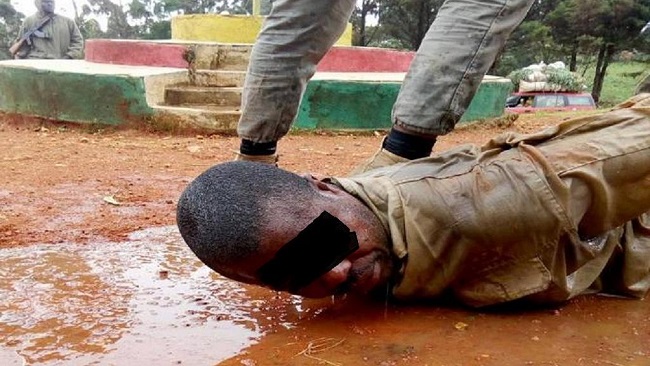
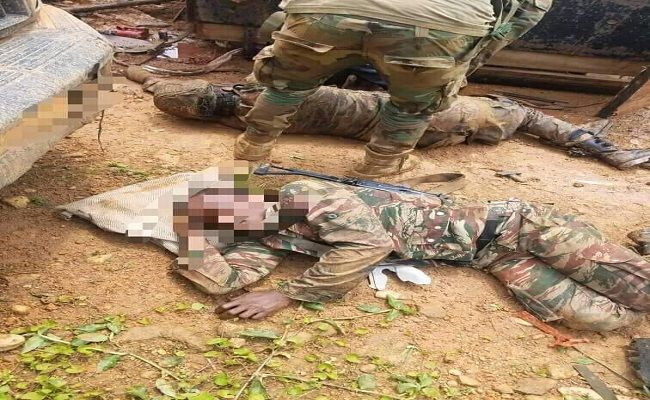
A viral social media video showed officials having tied the suspects hands behind him. The suspect who was lying on his belly in muddy conditions is kicked and his head is stamped upon by some of the gendarmes and a police.
The gendarmes (paramilitary officials) are “clearly out of the norms and legal techniques in such circumstances,” the minister acknowledged, his condemnation followed a very strong online protest to the video.
It is the first time the army has acknowledged abuses committed by security forces deployed in the two English-speaking regions riled by separatist violence since October 2017.
“An investigation has been opened to identify (and) where appropriate sanction the perpetrators of these acts contrary to respect for human rights,” said the minister.
Nicknamed “general”, the abused person is an alleged separatist leader who was arrested on Saturday, said Beti Assomo. The said general according to authorities “was actively sought for several weeks for his involvement in acts of violence against the population and (in) the killing of the personnel of defense and security forces”.
Security forces have been repeatedly accused by NGOs and witnesses of abuses and burning houses. “We only burn houses where we discover weapons,” the army defended its actions in late April.
The central African regions English speaking regions have been mired in a security crisis that has been tagged the “Anglophone crisis”. In the two regions, northwest and south-west, fighting has become almost daily between the Cameroonian security forces and armed men.
The armed groups say they are fighting to establish an independent Ambazonia Republic. According to the International Crisis Group (ICG), “at least 120” civilians and “at least 43” members of the security forces have been killed since late 2016. The separatist record is unknown.
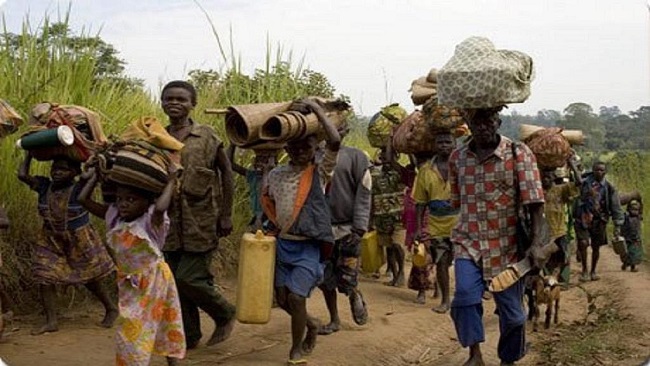
160,000 people have fled their homes as a result of the violence, according to the UN, and 34,000 have fled to Nigeria, according to the Nigerian Emergency Management Agency (Sema).
Source: Africa News












16, May 2018
Bundes: Merkel joins European allies in reaffirming support for Iran nuclear deal 0
Germany has joined its European allies in reaffirming support for the Iran nuclear deal in defiance of the US that pulled out of the landmark agreement last week.
German Chancellor Angela Merkel on Wednesday pushed back against Washington’s rejection of the Iran nuclear deal, and reasserted a defense of the agreement in remarks to lawmakers in the Bundestag lower house of parliament.
She also said that Iran was complying with its commitments under the deal, officially known as the Joint Comprehensive Plan of Action (JCPOA).
US President Donald Trump announced on May 8 that Washington was walking away from the JCPOA, which was reached between Iran and the five permanent members of the UN Security Council — the US, Britain, France, Russia and China — plus Germany in 2015.
Trump also said he would reinstate US sanctions on Iran lifted by the accord and impose “the highest level” of economic bans on the Islamic Republic.
The deal lifted sanctions in 2016 in return for Tehran limiting its nuclear program.
Iran has reiterated it would remain in the JCPOA for now, pending negotiations with the other signatories in the coming weeks before making a final decision on its future role in the agreement.
Meanwhile, Iranian Foreign Minister Mohammad Javad Zarif met EU foreign policy chief Federica Mogherini and his counterparts from Britain, France and Germany in Brussels on Tuesday.
Following the meeting, Mogherini told reporters that European top diplomats had agreed to follow through the Iran nuclear deal despite Trump’s decision to withdraw.
To this end, the EU will launch intensive discussion at all levels with Iran in next few weeks, she said, adding that the discussion would focus on, among others, how to maintain economic relations and effective banking transactions with Iran in the context of renewed US sanctions.
She noted that similar willingness has been expressed by the European and Iranian sides.
Before visiting Europe, Zarif first traveled to China and later Russia, the two other signatory nations that have supported the JCPOA, on the first leg of his diplomatic mission.
Meanwhile, in their first meeting since the US withdrawal from the JCPOA, EU leaders are expected to meet to explore options on Wednesday for keeping the Iran nuclear deal alive and protecting their reviving economic cooperation with Tehran.
“I would like our debate to reconfirm without any doubt that as long as Iran respects the provisions of the deal, the EU will also respect it,” the chairman of the gathering, Donald Tusk, said before the meeting in the Bulgarian capital Sofia.
Russian President Vladimir Putin will also host Merkel on Friday to discuss, among other issues, the Iran deal.
Source: Presstv