8, February 2022
AFCON and French Cameroun: there was no mention of Marc-Vivien Foé at the tournament 0
The tragedy of Marc-Vivien Foé’s death hits much harder at his gravesite.
It overlooks a soccer field, but not the kind the late Cameroon and Manchester City player wanted. The goalposts are part of a shoddy metal frame, unpainted and leaning to one side. The field is bare earth and lined with trash.
There’s a crumbling building nearby with windows and parts of walls missing. The whole site once became a haven for criminals and drug users.
This was meant to be Foé’s dream.
When Foé collapsed on a field while playing for his country at FIFA’s Confederations Cup in 2003 and died in an awful moment for world soccer, he was in the process of building a sports complex and school in the eastern outskirts of his hometown of Yaounde. It was to be his legacy, his gift to his people and a precious resource for budding young soccer players in a part of the world where they get little help.
Foé never got to finish it and instead it became his final resting place.
But at Foé’s funeral, when he was buried with military honors and hailed as a “fallen national hero,” promises were made by representatives of the Cameroon government that the project would be completed in his memory. Nearly 20 years later, it’s in ruins. The only part of the complex that isn’t broken down is the marble block that marks Foé’s grave.
Foé’s nephew, Nama Mvogo, says he visits every week to clean the grave. Every time, he’s struck by how forsaken it appears.
“I feel that my uncle has been abandoned,” Mvogo said. “Even to come and see his tomb, (there’s) nothing. It’s deplorable.”
The last month has been a painful one for Mvogo as he watched his central African country host the African Cup of Nations, the continent’s biggest soccer tournament, for the first time in 50 years. It’s a tournament Foé won twice with Cameroon and Mvogo thought it would be the perfect opportunity to revive Foé’s project, or at least recognize him.
But there was no mention of Foé at the tournament, Mvogo said, and watching Cameroon’s current team play at this African Cup invoked nothing but sadness for him.
Foé played for Cameroon for a decade and also became a popular player in England with West Ham and Manchester City. He died at the age of 28 from an undiagnosed heart condition, which was discovered in the days after he slumped to the ground in the center circle at the Gerland stadium in Lyon, France during the Confederations Cup semifinal against Colombia. It united world soccer in grief.
Tens of thousands lined the streets of Yaounde for his funeral procession. Then-FIFA President Sepp Blatter and Cameroon President Paul Biya attended the service but Foé’s true value as a person was only revealed when an unknown 14-year-old boy stood up and explained how the soccer star had been paying for him to attend a special center for the disabled.
Since then the academy project fell into disrepair. Mvogo said its future is complicated and Foé’s father and widow, who live in France, and the government haven’t been able to work together to revive it.
But it’s not completely abandoned.
Two small soccer schools make use of the land, somehow managing to train and play games in the dirt near Foé’s grave. The original field Foé marked out was overgrown with palm trees long ago, Mvogo said.
Goalkeeper David Neabo, who plays for an under-9 team, stands under those crooked goalposts clutching a ball. His coach, Ewodo Yves Laurent, said he still invokes Foé’s memory to inspire the kids, who weren’t even born when Foé died and can’t really grasp his success from the dilapidated state of the academy.
“I tell them about Marc-Vivien Foé, who also motivated me to come here,” the coach said. “When I look at what he did, what he became in life, I ask myself why not sustain his dream?”
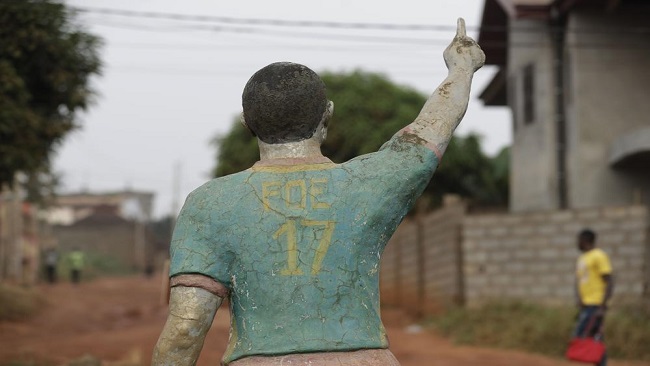
The only image of Foé at the complex is a statue of him in Cameroon’s team uniform, his right arm raised in celebration. But its proportions are not quite right and the figure appears stunted and doesn’t resemble the powerful 6-foot-2 midfielder Foé was. Years of neglect have chipped away at it and Foé’s green Cameroon shirt is faded and discolored.
Mvogo doesn’t know if his uncle’s dream will ever be realized but a recent incident did give him hope for the future. He came across Eric Djemba-Djemba, the former Manchester United midfielder and Foé’s Cameroon teammate, visiting the grave.
“He said he couldn’t afford to be in Cameroon and not stop here,” Mvogo recalled.
Foé’s memory, at least, remains alive for some.
Culled from AP











8, February 2022
Battle for Independence: Mali 2 France 0 0
Mali’s prime minister on Monday accused France of having sought the partition of the west African country during its military mission there, the latest flare-up in relations between Paris and Bamako.
In a 45-minute speech to diplomats gathered at his request, Choguel Kokalla Maiga denounced France, the former colonial power and a vocal critic of the military regime that appointed him.
But Maiga stopped short of calling for the departure of the anti-jihadist force that France leads in Mali.
He acknowledged that France’s military intervention in 2013 had halted a jihadist insurgency that had already captured the north of the country and threatened the south.
But, the French operation later turned into a de facto partition of the country, he argued.
The jihadists were allowed to take refuge in part of Mali’s territory, regroup and return in force from 2014, said Maiga.
And drawing a parallel with the Allied liberation of France at the end of World War II, he added: “When the French judged that (the US presence) was no longer necessary, they told the Americans to go.
“Did the Americans start insulting the French?”
Tensions have been mounting after French President Emmanuel Macron lashed out at Mali’s failure to stick to a timetable for a return to civilian rule.
Mali stepped up its denunciations of France after the European nation reportedly got the EU and the so-called West African bloc ECOWAS to sanction the people of Mali and their government.
Bamako has accused Paris of having manipulated ECOWAS into its hard line against Bamako, a theme Maiga returned to in Monday’s speech.
The aim had been to present Mali as a pariah, he said.
“We cannot be turned into vassals,” he added. “You cannot enslave the country. That is over,” he said, a reference to the country’s past as a colony of France.
Reported by AFP with additional editing by Camcordnews