16, May 2021
CPDM Crime Syndicate: Minister Mengot’s bullying campaign generates stress among militants 0
There seem to be a mad rush in Yaoundé for those who still believe in the CPDM criminality. When you take a look at the number of people who have paid for the burial of the Senate Vice-President, Chief Mukete, and Member of Parliament, Emilia Lifaka Monjowa, who died a few days apart, you would think those pouring money into the account set up by the Minister in Charge of Special Duties at the Presidency, Victor Mengot Arrey Nkongho, are doing so happily.
On the surface, all is fine, but if you scratch beyond the surface, you will find out the truth. Like most Cameroonians, these CPDM civil servants are also struggling, but they cannot complain. The CPDM creed is that “thou shall not complain even when you are hurting.”
These miserable members of the crime syndicate have been caught between the rock and a hard place. He who eats, drinks and dances with the devil will always be miserable and this all too true with the fake members of the ruling CPDM.
Many are contributing against their will. Mengot’s surrogates are breathing down their throats and since all of them are hoping that their affiliation with the ruling CPDM could one day yield a small appointment, they are emptying their piggy banks just to please Mengot whom they think will one day recommend them.
Behind the scenes, the grumbling is getting louder. CPDM members in the Southwest region are sick and tired of their own party that is causing their blood pressure to be skyrocketing. They claim that money is hard to come by, but power-hungry elites like Victor Mengot are intimidating them into spending their last penny.
According to a CPDM member who contacted our London Bureau Chief, many of those contributing are doing so against their wish. She said that CPDM members were paying that money with lots of regrets, especially as they are facing huge challenges in paying their bills.
“Our people are paying in anger and under a cloud of intimidation. Mengot is clearly a bully. Why wasn’t there a drive when W.N.O Effiom died,” she asked.
“Chief Tabeta, Chief Akomara and others had nothing despite dying recently? Why should there be double standards in the contributions,” she added.
“Our people can’t pay for hospital consultations in Manyu and Mengot has never bothered. All other Divisions are given CFAF 2 million without fund drives. Why must the people of Manyu be tasked to pay for people who are not even from Manyu Division,” our source asked angrily.
“Now Mengot intends to give small amounts as gestures to the families of our Chiefs who died recently. Why did he not think about that before they were buried? This is an insult,” she added.
“Will he present an account of the money at the end of the exercise,” our source quipped.
Below is a list of those who have been bullied into paying for the burial of the two personalities who are supposed to receive allocations from the government.
Manyu Contribution towards funerals of Hon. Nfon V. MUKETE & Hon. Emilia LIFAKA
No Name Amount
1 H.E Victor Mengot 500,000
2 Sen. Nfor Tabetando 500,000
3 Pr. Echu George 200,000
4 Chief AKO TAKEM Chancel 200,000
5 Pr Gloria Some A. 50,000
6 Dr Nkengasu W. oben 30,000
7 Hon. Tanyi TEKU TEKU 150,000
8 H.E MBENG Martin 300,000
9 Mr Edward ABE ETAWO 20,000
10 Pr.ENOWOROCK George 30,000
11 Mr. MANOJI Benedict MUMA 30,000
12 Bar. ABANG TABI Andy 20,000
13 Pr. George ELAMBO NKENG 150,000
14 Hon. AKA Martin 150,000
15 Mr Enoh Peter AYUK 100,000
16 HRM Dr. ORUH Julius AGBOR 20,000
17 HRM MBI ORU Michael 20,000
18 Mr Tambi Joe 20,000
19 Mr AGBOR OBEN E. 25,000
20 Mr Manghe Donatus Asu 100,000
21 Mr Ojong Stephen Ayukogem 20,000
22 Dr Agbor Ambang 50,000
23 Mr OBEN James Agbor 20,000
24 Dr Eyere Mispa Tambe 50,000
25 Pr. MBU Robinson 150,000
26 Mr.AKO Harrison EKU 10,000
27 Dr Etah Collins Ayuk 100,000
28 Hon. Johana Agborntui.Ebangha 150,000
29 Mme NDIEP ASSAM MBIWAN 25,000
30 Pr Agborbechem Peter 30,000
31 Dr Carl Enow Ngachu 100,000
32 Dr EGBE Samuel 30,000
33 Mr Tanyitiku Enohachou Bayee 150,000
34 Mrs Ayuk Sera 30,000
35 Dr Tambi Sammy Ako 100,000
36 Mr Ekwalle Martin Ekwalle 50,000
37 Sir Eyong Echaw Nat 15,000
38 Mr AKAT Fidelis 50,000
39 Dr Etta Arreybessong AKO 25,000
40 Dr Etengene Johanes OJONG 20,000
41 Chief Pr AKO E. OBEN 100,000
42 Mrs EYA AYUK Scholastica 20,000
43 Mme Eteng Doris 25,000
44 Mr Moses ETA Enow 20,000
45 Mr simpson Tabe Ayuk 20,000
46 Mr Ayuk Raphael Arrey 10,000
47 Mrs Bessong Helen Eyere 30,000
48 Mr Godfred Betek Tabi 30,000
49 Mr AWUH Mbia Ekolok 10,000
50 Hon Walter Tarkang 50,000
51 Dr Okie Tabi Philip 30,000
52 Mrs Ebai Pauline 25,000
53 Mrs Matilda Nkwo 20,000
54 Councillor Nkaie Moses Eyong 20,000
55 Chief Orock John 15,000
56 Major Etchu Joseph Eyong 50,000
57 sisiko Akwo Pius 30,000
58 mme AgborTambe Martina 30,000
59 Dr Etchu kinsley 25,000
60 Mrs Carine Ondatess Ochikwa. 30,000
61 Sen.chief Dr Anja Simon 150,000
62 Mr Eyong paul Ayukegbe 25,000
63 Pr Agbor Ntui Michael 25,000
64 Mr Teddy Tambeagbor Tabekwere 25,000
65 Mr ENO Chris OBEN 10,000
66 Bar Kenneth Odi Odi 30,000
67 Mme Bessem winifred Ayuk arrey 20,000
68 Mme Ayukegba Evelyn 50,000
69 Mme Orock Comfort Agbor 50,000
70 Mr ABEY Napoleon NTUI 10,000
71 Mayor Ashu Robertson Tabenchong 50,000
72 Pr Ndip Roland 50,000
73 pr Egbe Andrew 25,000
74 Mr Hastings Eta Ebua 10,000
75 Mrs Roseline Arongagbor 20,000
76 Mr Tanyitiku Bayee Arikia martin 30,000
77 HE.chief Clarson Mbianyor OBEN 50,000
78 Chief TAMBE Adolf Tanchie 25,000
79 Mr Esua John 100,000
80 Mrs Egbe Sabina 10,000
81 H.E Pr. Sarah Agbor 200,000
82 Dr Ogork Ntui Bessong 150,000
83 Mr Adah Consoler Terkula 10,000
84 Chief Dr OBEN GODSON 30,000
85 Bar. Atem Anya Molotov 20,000
86 Mrs Ekwalle Emilia 25,000
87 Dr mrs Agbor Magdaline Tarkang 25,000
88 Mr Orock Thomas 30,000
89 HRM Ayamba Ita Jacques 50,000
90 Bar. Forchack Forchack Valentine 20,000
91 Pr. EBOT EBOT 150,000
92 Mr Tabot Martin 75,000
93 Mr Epey Samuel 30,000
94 Mr Anja Gilbert Tiku 20,000
95 Mr Agbor Sampson Eyong 30,000
96 ANNONYMOUS 150,000
97 Mr.NDIP Carolyn Ewube 15,000
98 Mr Julius Nkom 20,000
99 Mrs Arrey Magdaline Eneke 10,000
100 Mr. Akomara Jerry Eta 25,000
101 Dr Mrs Ojongnkot Comfort Beyang 15,000
102 Mr Enow Kenneth 75,000
103 Mrs Helen AGBOBESSONG 15,000
104 Mme Emilia Forngang 20,000
105 Pr Obinchemchi Egbe 20,000
106 Mme Valentina Tanyitiku Bessem 30,000
107 Mr Francis Manchang Oben 30,000
108 H.E Jerome Obi ETA 100,000
109 Hon. susan Okpu 20,000
110 Annonymous 100,000
111 Dr Enake Tanyitiku 20,000
112 Pr Maureen Tanyi 15,000
By Soter Tarh Agbaw-Ebai with files from Rita Akana in Yaounde













16, May 2021
The war in Southern Cameroons and why the people of Ambazonia are fighting 0
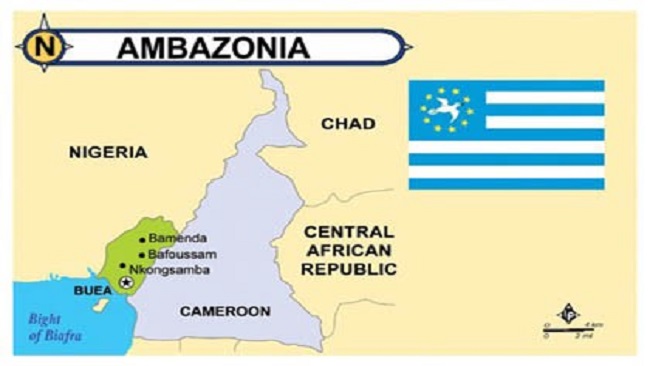
Nota: Ambazonia is the indigenous name of the former United Nations trust territory of the Southern Cameroons under United Kingdom Administration for close to half a century, excluding the period of British connection with the territory from 1843 to 1887. When Republique du Cameroun took control of the territory, it split it into two parts and designated them as “northwest and southwest provinces/regions of Republique du Cameroun.” This was rejected and continues to be rejected by the people of the former British Southern Cameroons. The people of the territory insist on the indigenous name of their Homeland which is Ambazonia. This is consistent with a 1978 recommendation of UNESCO that African countries should call their countries by the name they wish to be known. Here, the designations ‘Ambazonia’ and ‘the Southern Cameroons’ are used interchangeably.
Background
Imposed plebiscite: The Southern Cameroons was one of the territories set for decolonization in the context of the UN decolonization agenda. Britain’s devious handling of it and the British wheeling and dealing at the UN in 1959 and 1960 caused a great historical injustice to the people of the Southern Cameroons. That injustice continues to cry out for redress. British action resulted in the unconscionable imposition of an unnecessary and precipitated plebiscite with dead-end alternatives. Speaking through Lord Perth, Britain shamefully said the Southern Cameroons and its people were “expendable”.
The plebiscite was imposed in the teeth of opposition by the leadership of the trust territory. It offered Hobson’s choice of ‘joining’ either Nigeria or French Cameroun. The internationally-prescribed political status option of sovereign independence was deliberately excluded. There was no good reason for doing so. On 11 February 1961, a skewed plebiscite was foisted on the people of the Southern Cameroons. Faced with the Hobson’s ‘choice’ that was forced down their throat, the people opted for independence in political association with Republique du Cameroun. It was agreed in writing between the two countries and to the knowledge of Britain and the UN, that the political association would take the form of an aggregative federation of two states, equal in status.
In 1959, hoping to sway the Southern Cameroons to associate with it rather than with Nigeria, Republique du Cameroun had taken the floor at the UN and had solemnly given the assurance to the world at large that it would not take advantage of its bigger size and population to annex the Southern Cameroons in the event of political association between the both countries. Shockingly, that country did exactly the opposite of what it had vouchsafed at the UN. It unilaterally framed, adopted and promulgated a ‘federal constitution’ creating the Federal Republic of Cameroon and asserting claim to the territory of the Southern Cameroons as part of the territory of Republique du Cameroun returned to it by the UN and the UK. In October 1961, Republique du Cameroun in effect took control of the Southern Cameroons, aided in that by Britain. It militarily occupied the territory and appointed one of its officials as officer administering who stepped into the shoes of the departed British Commissioner of the Southern Cameroons. It then started visiting the people of the Southern Cameroons with terror and cruel depredations: arbitrarily arresting and imprisoning, torturing, and killing at will, unchecked neither by law nor morality. At the same time, the territory was being looted and plundered. Spoliation of Southern Cameroons’ natural resources was entirely for the benefit of Republique du Cameroun. Cameroun 60-year colonial occupation, oppression and repression has been experienced by the people of the Southern Cameroons as far worse than anything ever experienced under British colonial rule.
Transfer of administration to French Cameroun. Before exiting the Southern Cameroons on 1 October 1961, Britain transferred powers to Republique du Cameroun rather than to the Southern Cameroons as ought to have been the case and as required under international law. This British self-confessed transfer resulted in the recolonization, rather than the decolonization, of the Southern Cameroons. Spain may have borrowed a leaf from Britain’s bad and illegal conduct when in 1975 it transferred administration of the Western Sahara to both Morocco and Mauritania and hurriedly left the territory. On 14 November 1975 there was concluded a Declaration of Principles on Western Sahara between Spain, Morocco and Mauritania, whereby the powers and responsibilities of Spain, as the administering Power of the Territory, were transferred to a temporary tripartite administration.
Formal annexation of Ambazonia: In 1972 Republique du Cameroun despotically ended the subterfuge of a federation and formally annexed the territory of the Southern Cameroons as part of its territory. The Government of the Southern Cameroons was dismissed and its parliament dissolved along with the police and the public service of the federated state. All property, including artefacts, official documents and other archives, belonging to the Government of the Southern Cameroons was vandalized, destroyed in situ or carted to Yaoundé and simply burnt to ashes. The reason for this barbarism was to erase any memory of the Southern Cameroons as a congener of statehood. Republique du Cameroun however continued to camouflage its predatory and expansionist politics under the cloak of what it instituted as the so-called ‘United Republic of Cameroun’. But even this pretense could not be maintained for long. In 1984 Republique du Cameroun informed the world that it had reasserted its identity as such. But incongruously, and in continuing defiance of international law, it kept up the fiction that the territory of the Southern Cameroons is part of the territory of Republique du Cameroun. Prior to October 1961, the Southern Cameroons never had any ties of any nature with that country. Moreover, the Southern Cameroons does not have, and has never had, any connection whatsoever with France, the parent state of Republique du Cameroun.
The War in Ambazonia
Since the 1970s, Southern Cameroons Civil society organizations and individuals periodically organized nonviolent protests and sent deputations and petitions to the Yaoundé authorities calling for the redress of legitimate grievances, including the ending of its colonization and annexation of the Southern Cameroons. These actions were always met with characteristic violent repression, imprisonment, torture, and killings. In 2016, Southern Cameroons’ lawyers, all in their wigs and gowns, staged a peaceful public demonstration calling for an end to the organized systematic destruction of Southern Cameroon’s common-law-based legal and judicial system. The reaction of Yaoundé was swift and ferocious. Gendarmes encircled the lawyers as they marched, battered them and ripped off their wigs and tore their gowns, arbitrarily arresting and imprisoning, and torturing many of them. Teachers and a consortium of civil society organizations soon joined the action by the protesting lawyers. They called for an immediate end to the bastardization of the English-derived system of education obtained in the Southern Cameroons. They also called for an end to the policy of pauperization of the Southern Cameroons and its people. Again, these actions were met with the most brutal response, including the deployment of armed soldiers who did not hesitate to shoot and kill.
When the population came out en masse with peace plants to protest these wanton killings, the soldiers fanned out all over the Southern Cameroons and visited the people – women, men, boys, girls, children, the old, the sick and the infirm – with despicable mayhem. But still the people came out in protest. Mr Biya, Cameroun’s 88-year-old President for 40 years, and then publicly declared that his troops would do what he has ordered them to do in the Southern Cameroons. And so, the four-year old war in Ambazonia was unleashed on the people of the territory by Republique du Cameroun in November 2017. Taken by surprise and never being prepared for war, the people found themselves having to defend themselves, their families, their communities and their territory literally with bare hands. They used pebbles, sticks, machetes and a few old rusty hunting Dane guns and gunpowder retrieved here and there.
The War in Ambazonia has already claimed at least 40 000 lives, almost all of them civilian children, men and women, murdered by Cameroun troops in a series of targeted killings, organized massacres, and killings by fire in over 400 villages burnt down to ashes across Ambazonia. Over half a million people have been forcibly displaced as refugees living in various countries and especially in refugee camps in Nigeria. Over another half a million people have become IDPs hiding in forests, caves and hills due to forced displacement. Additionally, over 1.5 million people are facing a humanitarian disaster.
Republique du Cameroun uses not only arson and the destruction of food, livestock, and crops in the fields as weapons of war. It also uses rape. Rape of Ambazonian women and girls by Cameroun troops is systematic and widespread. These agonizing situations are compounded by the fact that a high percentage of Cameroun troops are HIV positive and also have other STDs. When they rape they infect the women and girls. This appears to be part of the genocide agenda of Cameroun. Reports are now emerging of scores of school girls raped, impregnated and infected by Republique du Cameroun’s troops. This poses a nightmare not only of the HIV and STD infections but also of rampant teenage pregnancies. Cameroun troops have burnt down health facilities and killed health workers in rural and semi-urban areas. Accessing health facilities or health practitioners is a huge challenge for rural and semi-urban folks.
Why the people of Ambazonia are fighting
Self-determination under international law: The people of Ambazonia are fighting to vindicate their unquestionable and inalienable right of self-determination. They will continue to fight until self-determination is achieved. The right of self-determination is a norm of jus cogens. It is fortified by the internationally-secured territorial framework of the territory of Ambazonia, a framework standing firmly on two territorial treaty-based pillars.
Legitimate rejection of colonialism in any form, shape or manifestation: The fight of the people of Ambazonia also represents a strong and unyielding rejection of colonialism in any form, shape or manifestation. The rejection is consistent with international law which gives colonized people struggling for their liberation the right to the assistance of third parties.
Territory secured by boundary treaties: The territory of Ambazonia is safeguarded by international treaties. Ambazonia’s international boundary to the north and to the west down to the Bakassi Peninsula is well defined by, and is now demarcated on the basis of, the Anglo-German treaty of 1913 specifying the boundary between the British territory of Nigeria and the German territory of Kamerun. Ambazonia’s international boundary to the east is defined and demarcated on the basis of the Anglo-French treaty of 1916. The boundary alignment was endorsed in 1919 at the Treaties of Versailles, confirmed by the League of Nations in 1922, and reconfirmed by the Anglo-French treaty of 1931 respecting the boundary between the British Cameroons and French Cameroun. The territorial integrity of Ambazonia is thus firmly secured under international law.
Title to territory and the principle of uti possidetis juris: Sovereign title to the territory of Ambazonia belongs to the people of Ambazonia, and not to any other people. The people of Ambazonia are entitled to the integrity of their territory. And this means Republique du Cameroun, which achieved its independence from France on 1 January 1960, must respect the integrity of its own territory, respect the AU core principle of intangibility of African borders as obtained on the day of achievement of independence, and abandons its pursuit of the internationally wrongful conduct of territorial expansionism.
Historical parallels
There are illustrative historical parallels to the darkness that has befallen Ambazonia. The parallels are: Morocco’s occupation and attempt to annex the Western Sahara; Imperial Ethiopia’s occupation and attempt to annex Eritrea; Indonesia’s occupation and attempt to annex East Timor; and apartheid South Africa’s occupation, refusal to leave Namibia and attempt to annex it. Predictably, all these cases led to wars of national liberation. And in all of them each latter-day colonial occupier/oppressor lost.
A Cameroon Concord News and Cameroon Intelligence Report Production