14, June 2021
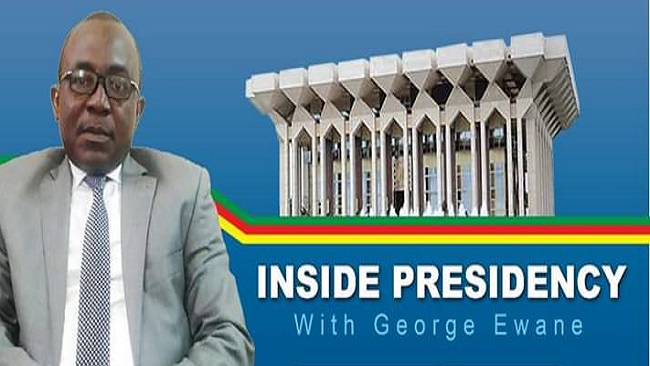
George Ewane is a shooting star and star 0
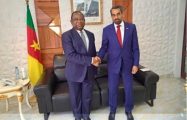
George Ewane Ngide, associate professor, recently appointed Technical Adviser at the Presidency of the Republic, is a shooting star, and appointment decrees or decisions shoot at him like meteoroids gone crazy in the galaxy.
In three years, since 2018, he has been appointed six times, up, up and further up the ladder. Appointments are obviously in search of worthy individuals and it is Ewane – him and nearly only him – the “best” ones find. Even if mannerism were the only criterion for all these, Ewane would deserve his fair share. He is, anyone can admit, a jolly good fellow, easy going, down to earth and, oh, that charming smile you may only miss in the dark or when you have an vision problem.
He was appointed, June 9, 2021, a couple of days after his sensational ENEMY IN THE HOUSE commentary over CRTV’s Cameroon Calling, in which some guess he might have been protesting against another very recent appointment and/or what he might have considered the gesticulations of regime hypocrites. Well, who the cap fits, let them wear it.
Before this June 9 appointment by presidential decree, Ewane was the beneficiary of a prime ministerial appointment and four CRTV board of directors’ decisions. On June 22, 2018, he was appointed technical adviser No. 4 at CRTV, which brought to an end his over 16 years record run as presidential correspondent, which he closed at the apex as Head of Division (Director) of the unit in charge of coverage of sovereignty affairs. Just over a year later, on June 26, 2020, he was appointed CRTV Radio Central Director. In between all that, he had been promoted to the CRTV professional apex of Editorialist.
His meteoric career progress notwithstanding, Ewane, who apparently found his way into journalism only by accident has been quoted by close friends as saying he has really never practiced journalism proper, as in news reporting because in his job assignments, he has been given more to commentaries.
Armed with a Maitrise in English at the time from the University of Yaounde under the wings of the late Professor John Lambo and the late Professor Gervais Mendo Ze, he found a place in the now scrapped Division 3 of the Advanced School of Mass Communication and, out of there, got recruited into CRTV. Many might have noticed him for the first on-camera when he anchor the live relay of World Cup 1998 matches from the studio in Mballa II alongside Francophone colleagues including Alex Mimbang, Valerie Dikos Oumarou and Emmanuel Mbede.
Ewane’s CRTV whirlwind rise was punctuated by his appointed by Prime Minister Dion Ngute as Spokesperson of the Major National Dialogue of September 30 to October 4, 2019. His appointment as Technical Adviser at the Presidency takes him “back home” where, as presidential correspondent for so long, he created and produced the TV programme “Insight/Inside the Presidency”, which The Guardian Post captures so aptly with the pun in its Sunday, June 13, 2021 edition front cover headline thus: George Ewane now “Inside the Presidency”.
On the academic sphere, the ex-student of GSS Nyassosso obtained a PhD in 2013 and got promoted to the academic rank of Associate Professor in 2020, but those were academic exploits, not appointments. Impressive all the same.
I believe and wish Ewane is or were more a star than a shooting star. They are not the same thing. CoolCosmos.Ipac.Caltech.Edu says, “Shooting stars look like stars that quickly shoot across the sky, but they are not stars. A shooting star is really a small piece of rock or dust [known as a Meteoroid] that hits Earth’s atmosphere from space. It moves so fast that it heats up and glows as it moves through the atmosphere leaving a short-lived trail of light called meteor.”
I should perhaps apologize for using the wrong analogy of a falling star to talk about a rising star; one that only glows briefly for someone who has been in the limelight and promises to remain there for long. In the language of Astrology, surviving meteoroids (falling stars) are paradoxically, those that hit Earth’s surface or simply put, those that fall to the ground, called Meteorites. The rest burn out in “flight” and disappear to nowhere. There is no scientific evidence to the contrary of the obvious, that the “surviving” ones fall to rise no more. At least, they are not known to germinate. But George Ewane is a star and stars shine up above in perpetuity, don’t they?
By Franklin Sone Bayen
*The author of this article, Franklin Sone Bayen, an Alfred Friendly (US) Press Partners Fellow, is a freelance investigative journalist, editorial writer and columnist. He can be reached (direct calls and WhatsApp) at: 656969090 and via email at: frankbayen@gmail.com








14, June 2021
Southern Cameroons War: Fighting continues around Muyuka, Ikata and Muea 0
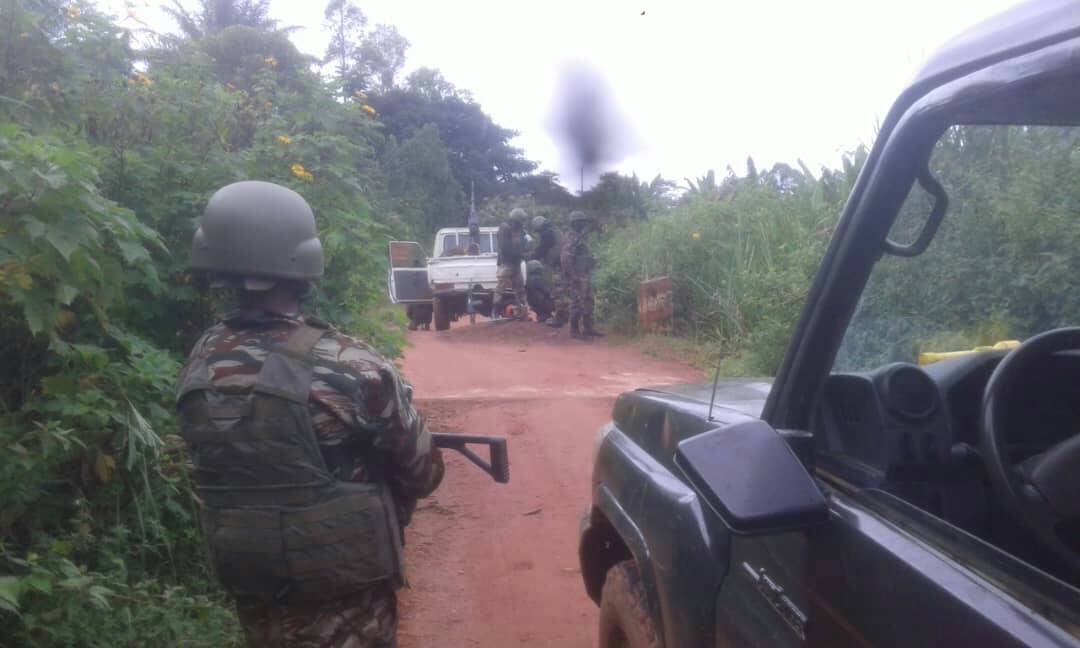
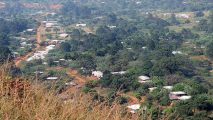
Fighting between Francophone Beti Ewondo troops loyal to the Biya regime in Yaoundé and Ambazonia Restoration Forces has continued today in Fako County with heavy artillery fire focusing on the strategically important towns of Muyuka, Muea and Ikata. Muyuka which sits on the only major road that links Buea the historic capital of Southern Cameroons to Meme, Ndian, Lebialem, Kupe Muanenguba and Manyu has seen fierce exchange in recent days as the Francophone Cameroon government forces attempt to gain control of the road.
The developments come as the conflict now in its fourth year is showing no signs of ending. The War in Southern Cameroons has already claimed at least 40 000 lives, almost all of them civilian children, men and women, murdered by Cameroon government troops in a series of targeted killings, organized massacres, and killings by fire in over 400 villages burnt down to ashes. Over half a million people have been forcibly displaced as refugees living in various countries and especially in refugee camps in Nigeria. Over another half a million people have become IDPs hiding in forests, caves and hills due to forced displacement. Additionally, over 1.5 million people are facing a humanitarian disaster. The Biya French Cameroun regime is yet to release casualty statistics for its armed forces, although military officials have reported that some 3000 Cameroon government army soldiers have died and hundreds more have been injured.
Further clashes in and around Buea are highly likely over the near term. Fighting along the main road linking Mamfe to Ekok and Bamenda to Wum cannot be ruled out in the coming days. A heightened Cameroon government security presence and disruptions to transportation have rocked the entire Southern Cameroons territory.
The latest round of hostilities erupted today when Ambazonia Restoration Forces reportedly carried out strikes on settlements in Muyuka and Muea including Ikata following attacks by Cameroon government troops. Ambazonia Restoration Forces launched what it claimed to be a ‘counter-offensive’ in response. Cameroon Intelligence Report understands that both Amba fighters and Cameroon government forces made extensive use of heavy weapons during the clashes, including artillery and loitering munitions.
The Southern Cameroons was one of the territories set for decolonization in the context of the UN decolonization agenda. Britain’s devious handling of it and the British wheeling and dealing at the UN in 1959 and 1960 caused a great historical injustice to the people of the Southern Cameroons. That injustice continues to cry out for redress. British action resulted in the unconscionable imposition of an unnecessary and precipitated plebiscite with dead-end alternatives. Speaking through Lord Perth, Britain shamefully said the Southern Cameroons and its people were “expendable”.
The plebiscite was imposed in the teeth of opposition by the leadership of the trust territory. It offered a Hobson’s choice of ‘joining’ either Nigeria or French Cameroun. The internationally-prescribed political status option of sovereign independence was deliberately excluded. There was no good reason for doing so. On 11 February 1961, a skewed plebiscite was foisted on the people of the Southern Cameroons. Faced with the Hobson’s ‘choice’ that was forced down their throat, the people opted for independence in political association with Republique du Cameroun. It was agreed in writing between the two countries and to the knowledge of Britain and the UN, that the political association would take the form of an aggregative federation of two states, equal in status.
Western governments generally advise their citizens against all travel to areas of conflict but have maintained a kind of deliberate silence ever since the crisis in Southern Cameroons started four years ago.
By Soter Tarh Agbaw-Ebai and Isong Asu