25, March 2021
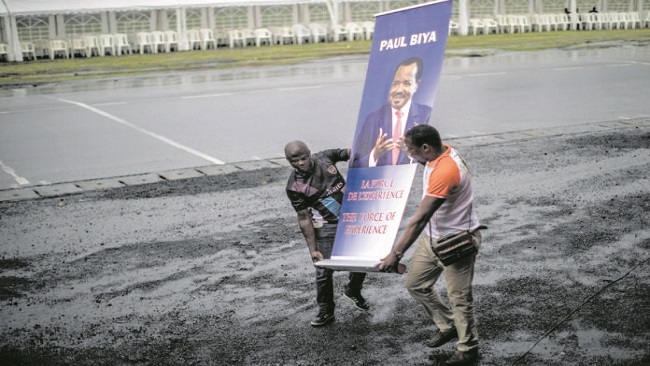
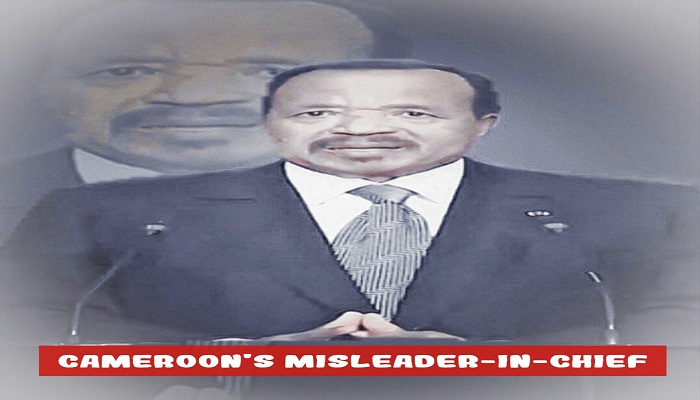
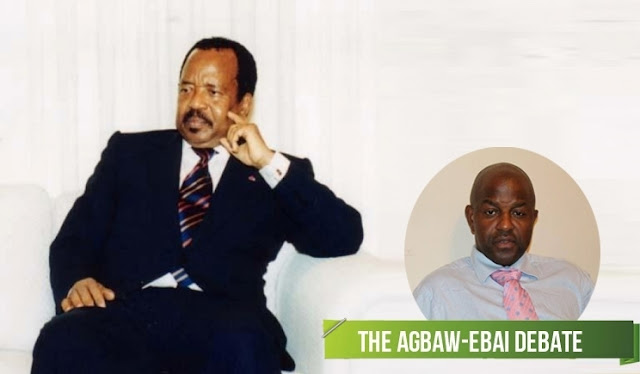
How to stay in power forever: A handy guide for President Biya and his other African leaders 0
1. Enrich yourself, your family and your allies. Don’t listen to those who tell you that amassing a personal fortune is the old-fashioned way. Just as you need a monopoly on violence, you need a monopoly on wealth creation. You and your family must live in the style commensurate with a sovereign national leader: the mansion and private jet are de rigueur if you are to be taken seriously as the power in the land. You need to sustain an expansive patronage network, and you need the cash to ensure your allies are well rewarded and your enemies are … well neutralised.
2. Build a complex and ruthless security system with competing spy agencies over which you have total control. Your system has two goals: to ensure that your subjects know that any attempt to organise against you would be met with stern measures, including extreme violence; and to keep you fully informed of what allies and rivals are doing at all times. Only a multiplicity of agencies – some spying on each other, but all reporting to you directly – will provide the actionable intelligence essential to your survival.
3. Adopt an overarching ideology that combines a sense of hope and nationalism, such as ‘African developmentalism’. This gives your regime the legitimacy it needs. You are a populist leader – never a dictator. The late lamented Mobutu Sese Seko stole and repackaged the ideas of anti-imperialist Patrice Lumumba, which enabled him to posture as a doughty nationalist. You must freely distribute – in the style of Mao and Stalin – millions of books of your deeply held beliefs. Organise mass rallies where people chant your slogans. Ensure that you bring musicians and singers. Remember: ideology plus bread and circuses.
4. Your role as commander-in-chief of the armed forces is your most important job. Political power grows out of the barrel of a gun, said Mao. Organise military parades regularly and allow public holidays for the purpose. Attendance by civil servants should be compulsory. Make sure you wear a full dress uniform bedecked with medals. Boost military spending massively and display your latest tanks and missiles at the parades. Ensure your generals fear and respect you. Reward loyalty with extreme generosity and repay any sign of treachery with extreme violence.
5. Buy the business elite and bribe their foreign friends. Win over top business people with contracts and concessions as long as they pay off your family and allies. You need friends of convenience in the business world to create a class that has a vested interest in your regime. Offer them monopolies in key sectors and make them pay you a percentage of their earnings. Did you say Cosa Nostra? Big foreign companies are even easier. Promise them legal protection and discretion, and they will aid and abet any business malfeasance as long as its lucrative.
6. Get smart about information. Invest heavily in fake news and propaganda against your enemies, and ensure the national story is your story. The internet can be your friend if you are canny. Pay your supporters to defend you and trash your enemies online. Play down accusations of censorship and paternalism. Instead be selective and just block specific publications and programmes that could threaten you. Filter the internet and pay hackers to attack opposition websites. Bribe journalists. If they won’t accept, find friendly businesses to take over the media companies. And if you really have to, occasionally shut down the internet.
7. Co-option is better than repression. Most opponents have a price, so find out what it is and make them an offer. Pick off your opponents one by one. Send in your bad cops, then be the good cop with an offer of a job – maybe to set up a committee to consider the reforms they are demanding. Show them how much more comfortable life can be inside the tent. Your goal is to divide their organisations and attack their credibility. There is nothing more demoralising for an opposition movement than to see one of its key leaders consorting with the president-for-life.
8. Blame the outsiders. Unite your people against the hidden hand of the enemies who threaten your dear country. When the power goes off or the harvest fails, go on state television and announce a search for the foreign saboteurs. If problems continue, nationalise a few foreign companies or seize their assets and hand them to your local allies, all patriots to the core. Organise a few show trials of selected saboteurs. Step up immigration controls.
9. Lie about the economy. Make sweeping announcements of change and promise everyone a brighter future. In the short-term, explain that we will all have to make sacrifices for the common good. Baffle people with lies, damned lies and statistics. Commission state television documentaries on the phenomenal increase in farm and industrial production. Blame at least some of the shortages on the diversion of resources towards our redoubtable national defence industry. Accuse the whining complainants of lacking patriotism.
10. Incumbency and patience are everything. You have the power. Stay on the throne and wait out your opponents. With the accumulation of power over a long period comes a sense of inviolability. This disturbs those around you, especially the ones foolish enough to harbour thoughts of succeeding you. Once in a while, sit them down and explain the realities of power. You have seen off all the most determined opponents for the betterment of your country … and of course for the defeat of its sworn enemies.
Culled from The Africa Report











25, March 2021
European leaders hold virtual summit focused on sharing Covid vaccine supplies 0
The looming third wave of coronavirus infections and Europe’s struggle to mount a vaccination drive will dominate Thursday’s EU video summit, despite a welcome guest appearance by Joe Biden.
The new US president will address the 27 EU leaders by video link in the evening as Washington and Brussels put on a show of mending ties after the dramatic diplomatic battles of the Donald Trump years.
But his intervention will only be a brief respite from the main matter at hand: How to outpace the resurgent epidemic when drug deliveries came up short and vaccination campaigns started slowly?
Host Charles Michel, the president of the leaders’ European Council, had hoped to hold a substantive face-to-face summit, but was forced to accept a stripped down video conference as EU members reinstated lockdown measures.
The Europeans are angry that UK-based pharma giant AstraZeneca has failed to meet its vaccine delivery promises to the EU while ensuring smoother supplies to former member Britain.
But they are also squabbling among themselves over how to share the vaccines they have received, and not all are happy with the European Commission’s threat to block some vaccine exports.
EU chief Ursula von der Leyen’s executive updated its month-old control mechanism on Wednesday, giving the bloc more power to block vaccine shipments to countries like Britain that produce jabs but do not export them.
The leaders will not be asked to vote on the measure, already provisionally applied, at Thursday’s summit, and most would back it if it helps pressure AstraZeneca to boost its deliveries.
But some — like UK neighbour Ireland, and vaccine producers Belgium and the Netherlands — are wary of any move to block exports from operations like Pfizer/BioNTech, which supplies both the EU and UK.
If the pharmaceutical industry’s global supply chains are disrupted, many countries could lose out, as both British Prime Minister Boris Johnson’s government and von der Leyen’s commission accepted.
‘Win-win situation’
“We are all facing the same pandemic and the third wave makes cooperation between the EU and UK even more important,” they said, in a joint statement released to calm nerves after the EU tightened its rules.
The cross-Channel rivals are in discussions about how “to create a win-win situation and expand vaccine supply for all our citizens” but have yet to come to agreement on how to share AstraZeneca doses.
The firm has delivered the EU only 19 million of the 30 million it had promised in the first quarter — and that pledge was itself a dramatic reduction from the 120 million it contracted for.
With some EU countries more reliant on the cheaper UK-designed vaccine than others, Brussels’ focus has turned to a plant in the Netherlands which the UK had planned to use for its own supplies.
Johnson is holding out, insisting that the UK contract with AstraZeneca must be honoured, but he is worried that Brussels could use the toughened export mechanism to cut Britain off from other EU-made vaccines.
A European diplomat told reporters that the UK and the Commission are negotiating how to better share AstraZeneca doses, and that the EU must not shoulder the shortfall alone.
Another sensitive issue is sharing out the vaccines Europe has received under the Commission’s joint buying strategy.
A group of smaller states, led by Austria, is demanding a revision in the distribution method after they came up short in the first quarter.
There is little sympathy in other capitals for their plight, however, as decisions were made on a joint steering committee where Austria and others failed to make use of opportunities to secure more batches.
Discussions are underway on a compromise, but some countries relied more heavily on AstraZeneca compared to more expensive — but in the end more successful — suppliers.
And, as one diplomat said: “Some countries just decided to buy fewer vaccines, it’s a tactic that can’t be blamed on the EU or other member states.”
Top envoy
Against this backdrop, Biden’s appearance, albeit by video from Washington, may prove a respite. European officials have been delighted with the new US administration’s warmer tone.
On the eve of the summit, Biden’s top diplomat Antony Blinken wrapped up a two-day visit to Brussels after talks with NATO ministers and top EU officials, promising close coordination.
But fearing leaks from a less than secure videoconference, the leaders do not expect to be able to make decisions on many sensitive topics, and talks initially planned for two days will instead end late Thursday.
(AFP)